
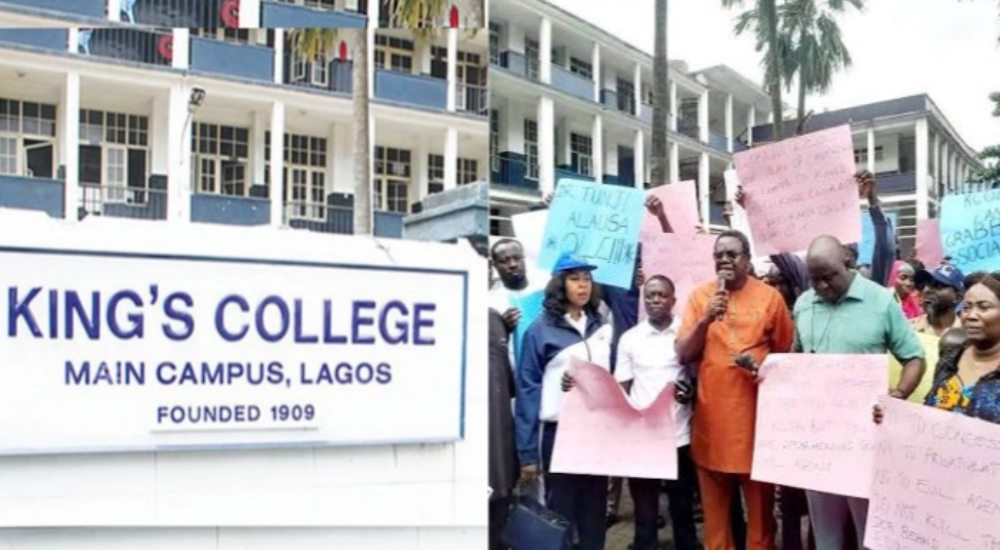
The Federal Government says King’s College, Lagos, is not for sale. But education unions have suspended the resumption of students across all Federal Unity Colleges, protesting what they describe as the proposed concession and privatisation of the 117-year-old institution.
The dispute has placed the future ownership, management and funding of one of Nigeria’s best-known secondary schools at the centre of a growing confrontation between the government and education-sector unions.
FG: King’s College Remains Publicly Owned
The Minister of Education, Tunji Alausa, said on Friday that the government would retain legal ownership of King’s College despite the proposed Public-Private Partnership (PPP) arrangement with the King’s College Old Boys’ Association (KCOBA).
In a statement issued by the ministry’s Director of Press and Public Relations, Folasade Boriowo, Alausa said KCOBA would take responsibility for financing, rehabilitating, modernising, operating and maintaining the institution under the concession.
The Federal Government, he stressed, would retain legal title as well as its statutory powers to regulate, inspect, monitor and enforce standards.
“This concession is not a sale of King’s College,” the minister said, adding that the arrangement was intended to bring in the investment and management expertise needed to strengthen the school.
Government Lists Safeguards
According to Alausa, the proposed concession passed through the government’s established PPP process.
He said the arrangement underwent assessments covering its technical, economic, financial, legal, environmental and social implications, as well as value-for-money, fiscal impact, risk allocation and commercial structuring.
The minister said the necessary regulatory procedures and Federal Executive Council approvals had also been obtained.
Rather than focusing solely on the controversy surrounding the concession, he urged stakeholders to assess the arrangement based on its eventual performance.
Among the areas he identified for scrutiny are:
- School infrastructure and facilities
- Academic performance
- Admissions
- Staff welfare
- Student safety and wellbeing
- Use of project funds
- Compliance with agreed performance targets
Alausa said the government would continue monitoring the arrangement and hold all parties accountable for their contractual responsibilities.
Unions Reject the Concession
The government’s explanation has not calmed the unions.
The Joint Congress of Unions of the Federal Ministry of Education announced the suspension of student resumption across Federal Unity Colleges in a communiqué dated September 10, 2026.
The suspension affects Federal Government Colleges, Federal Government Boys’ Colleges, Federal Government Girls’ Colleges and Federal Technical Colleges nationwide.
Resumption for the first term, which had been scheduled for Saturday, September 12, was suspended indefinitely.
The unions said the action was triggered directly by the proposed concession of King’s College, which they strongly opposed.
They argued that staff of the Federal Ministry of Education would not support the sale, concession or privatisation of King’s College or any other Federal Unity College.
Unions Accuse Minister of Avoiding Dialogue
The unions also accused Alausa of failing to meet with them despite repeated requests over the previous month.
They said the lack of engagement left them with no option but to suspend resumption in what they described as a defence of public education.
The Joint Congress called on parents, guardians, community leaders, School-Based Management Committees (SBMCs) and Parent-Teacher Associations (PTAs) to support its position.
It also urged major labour and professional organisations, including ASUU, NUJ, NLC and TUC, to back its opposition to the concession of King’s College and any similar arrangement involving Federal Unity Colleges.
Why the Dispute Matters
At the heart of the disagreement is a fundamental difference in how the arrangement is being described.
For the Federal Government, the proposal is a PPP concession that allows an external partner to invest in and manage the school while the government retains ownership and regulatory authority.
For the unions, however, handing operational and financial responsibility to an outside organisation represents an unacceptable step towards privatising a public institution.
That distinction is now driving the wider dispute.
The unions declared that “education must not be privatised” and said they would continue informing parents and the public as the situation develops.
A Test for the Government’s PPP Policy
The government insists that King’s College will remain a public institution and says the concession should ultimately be judged by its safeguards, investment commitments and measurable results.
The unions, meanwhile, want the proposed arrangement reversed and are using the suspension of resumption across Federal Unity Colleges to press their case.
The controversy therefore goes beyond one school.
It raises a broader question about how far the government should go in using private-sector partnerships to finance and manage public education institutions—and whether such arrangements can improve schools without weakening their public character.
For now, the government says King’s College is not being sold.
The unions say the concession must be stopped.
And until the dispute is resolved, thousands of students across Federal Unity Colleges face uncertainty over when the new academic term will begin.