
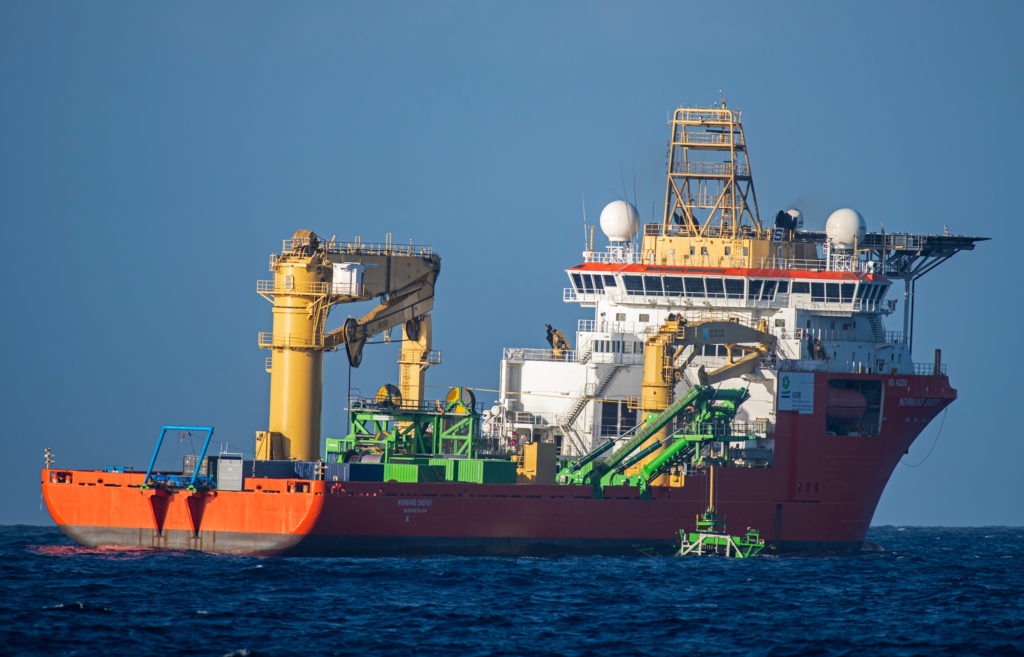
The next critical-minerals race may not happen on land. It may happen thousands of metres below the waves.
The United States and China are accelerating efforts to access mineral deposits on the ocean floor, opening a new front in the global competition for materials used in energy, technology and defence.
The stakes are enormous. Some estimates put the potential value of seabed minerals at up to $16 trillion. But the rush is creating a second question—especially in Africa:
Could money flowing into the deep ocean come at the expense of Africa’s vast, underdeveloped mineral resources? And what happens to ecosystems we still barely understand?
The answer is becoming increasingly important as governments weigh supply-chain security against environmental risk.
What lies beneath the seafloor?
The deep ocean is one of Earth’s least understood environments. Its seabed contains several mineral deposits that have attracted growing commercial and strategic interest.
The three main categories under exploration are:
- Polymetallic nodules: Potato-sized rocks scattered across deep-ocean plains. They can contain manganese, nickel, copper and cobalt.
- Polymetallic sulphides: Deposits associated with underwater volcanic activity that can contain copper, zinc, gold and silver.
- Cobalt-rich ferromanganese crusts: Mineral-rich layers that form on underwater mountains and can contain cobalt, manganese, nickel, platinum and rare-earth elements.
These resources matter because the same minerals underpin many modern technologies, from batteries and electrical equipment to advanced manufacturing and defence systems.
That has transformed the seabed from a scientific curiosity into a strategic resource frontier.
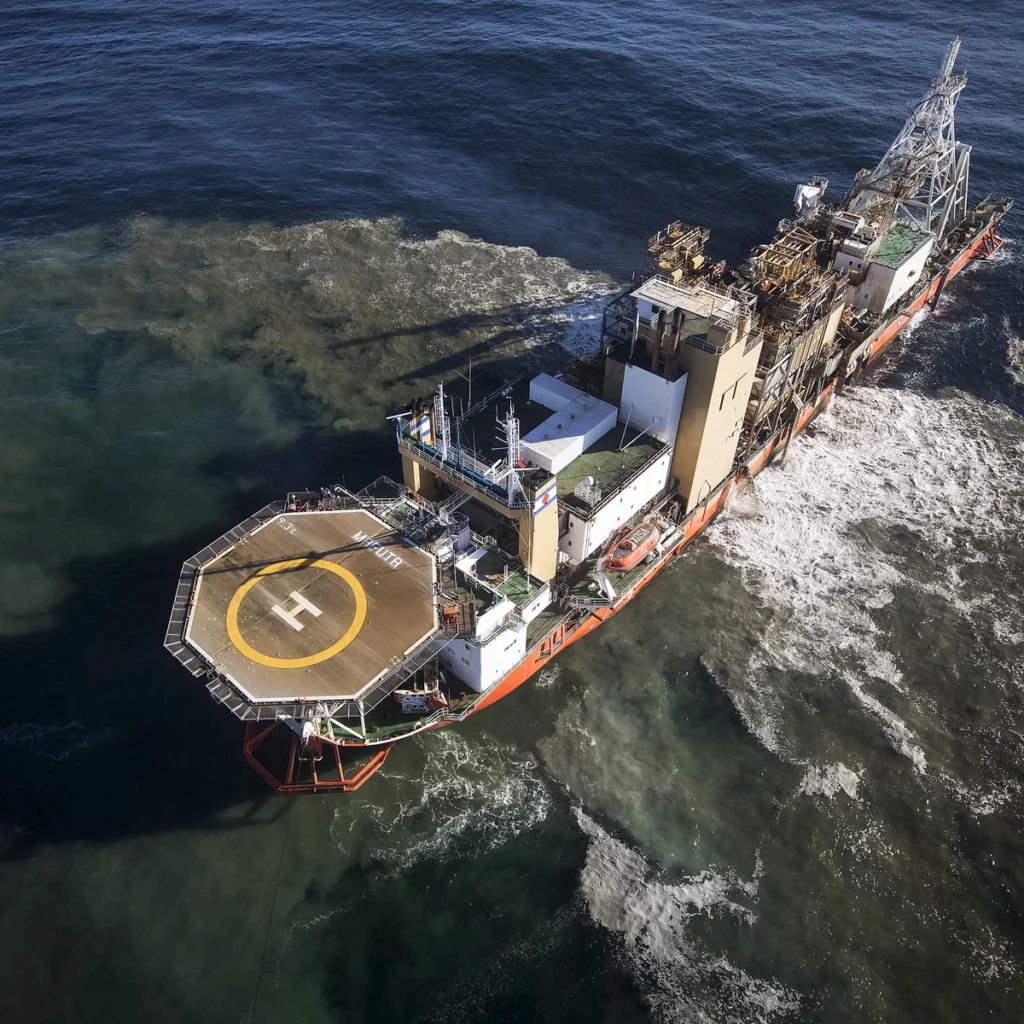
Washington and Beijing are competing for position
The United States wants to reduce vulnerabilities in critical-mineral supply chains, particularly its dependence on China for the processing of several important materials.
Washington made that objective explicit in April 2025, when President Donald Trump signed an executive order directing federal agencies to speed up seabed-mineral exploration and permitting. The order linked seabed resources directly to U.S. economic and national-security interests and called for measures to counter China’s growing influence in the sector.
The policy has since moved beyond paperwork.
In 2026, the U.S. advanced plans to auction potential seabed-mining rights around U.S. territories, including waters near American Samoa and the Northern Mariana Islands.
The approach is controversial because the United States has not ratified the UN Convention on the Law of the Sea, the treaty that underpins the international legal regime governing seabed resources beyond national jurisdiction. The U.S. instead relies on domestic legislation for its own seabed-mining framework.
That creates a wider geopolitical problem: who gets to set the rules when the resource race moves faster than international regulation?
You might want to read this: Why Nigerian Travelers Are Ditching Airport SIM Cards for eSIMs
China already has a significant head start
China has built one of the largest institutional and technological footprints in deep-sea exploration.
It holds five of the 31 exploration contracts administered by the International Seabed Authority—the largest number held by any single country. Those contracts cover all three major categories of seabed deposits.
China has also invested heavily in oceanographic research vessels, submersibles and other deep-sea technologies.
A 2026 investigation by Mongabay and CNN examined eight Chinese research vessels associated with seabed-mining exploration. Researchers found that the vessels spent only about 6.4% of their operating time inside designated ISA exploration areas over the five-year period studied. Much of their remaining activity occurred elsewhere, including waters considered strategically important by military analysts.
That does not establish that the vessels were conducting military operations. But it has intensified debate over the potential dual-use nature of China’s oceanographic capabilities.
China is also pursuing a permanent deep-sea research station in the South China Sea, with the project reportedly targeting operation by 2030. The facility is intended to support research into deep-ocean environments and resources, adding another layer to Beijing’s expanding deep-sea capabilities.
The result is a competition that is no longer simply about mining.
It is also about science, technology, maritime access and influence over the rules governing the seabed.
Why Africa is paying attention
Africa has its own enormous critical-mineral opportunity.
The Democratic Republic of Congo alone is widely estimated to have roughly $24 trillion in untapped mineral deposits, including globally important resources such as cobalt and copper.
That creates a strategic dilemma.
If global investors increasingly view seabed minerals as an alternative source of critical materials, African governments could face greater competition for capital, technology and processing investment.
But there is another opportunity: Africa could use the growing demand for critical minerals to push for more investment in domestic exploration, processing and value-added industries, rather than remaining primarily an exporter of raw materials.
The question, therefore, is not simply whether deep-sea mining should happen.
It is also whether Africa can capture more value from the mineral resources it already possesses.
Six African countries are now calling for caution
Africa’s position is becoming more visible in international seabed negotiations.
Malawi, Kenya, Madagascar, Mauritius, Mozambique and the Republic of Congo now support either a precautionary pause or moratorium on deep-seabed mining. Malawi became the first African country to take that position in May 2026, followed by Kenya and Madagascar in June. Mauritius, Mozambique and the Republic of Congo joined during the International Seabed Authority’s July meeting in Kingston, Jamaica.
Their argument is not necessarily that seabed mining should never happen.
It is that the science and regulatory safeguards are not yet strong enough to justify commercial exploitation.
Africa also has meaningful leverage inside the ISA. African states hold 10 of the organization’s 36 Council seats, giving the continent a substantial voice in negotiations over the rules that could govern future mining.
That influence could become increasingly important as countries disagree over how quickly the industry should move.
The environmental question is harder to answer
The commercial argument is straightforward: seabed deposits could provide additional supplies of minerals needed for the energy transition and advanced technologies.
The environmental equation is much less certain.
Deep-ocean ecosystems have evolved under conditions radically different from those on land. Many species remain poorly studied, and scientists still lack a complete understanding of how mining disturbances could affect food webs, habitats and ecological processes.
Potential concerns include:
- Physical destruction of seabed habitats
- Sediment plumes spreading beyond mining sites
- Noise and other disturbances affecting marine life
- Impacts on poorly understood deep-sea species
- Long-lasting or potentially irreversible ecosystem damage
Those uncertainties are central to the growing call for a precautionary pause.
By mid-2026, 46 countries had backed a moratorium or precautionary pause on deep-seabed mining, according to reporting from the International Seabed Authority’s July session.
The race is moving faster than the science
That may be the most important point in the entire debate.
The United States wants faster access to seabed minerals. China already has a major exploration footprint. Other governments and companies are developing their own capabilities.
Meanwhile, scientists are still working to understand what could be lost.
For Africa, the issue carries an additional economic dimension. The continent possesses immense mineral resources on land, but much of that wealth remains underdeveloped or exported with limited local processing.
So the deep-sea mining debate is ultimately about more than what lies beneath the ocean.
It is about who controls critical minerals, who attracts investment, who writes the rules—and who bears the environmental cost when the race accelerates.
The technology may eventually make deep-sea mining possible at commercial scale.
The harder question is whether governments can build enough scientific evidence, environmental safeguards and fair economic arrangements before the machines reach the seafloor.