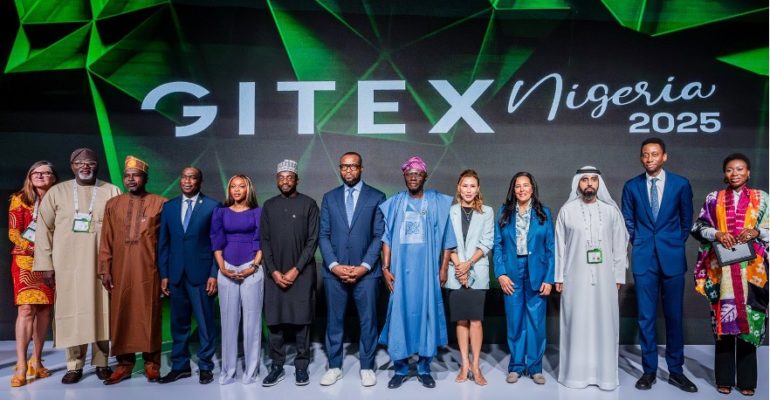
Nigeria is making a major push to become more than a consumer of artificial intelligence, investing in digital infrastructure, technical skills and policy reforms as it seeks a larger share of Africa’s rapidly expanding AI economy.
Nigeria wants to play a bigger role in Africa’s artificial intelligence revolution — and the country is increasingly putting infrastructure, talent and investment at the centre of that strategy.
The ambition will take centre stage when GITEX NIGERIA returns from August 31 to September 3, bringing government officials, technology companies, startups and investors together across Abuja and Lagos.
The event comes at a pivotal moment for Africa’s digital economy. Governments across the continent are increasingly looking beyond basic internet connectivity and asking a bigger question: who will actually build and control the technologies that power the next phase of economic growth?
For Nigeria, the answer it wants to offer is clear.
The country wants to move from being primarily a market for technology developed elsewhere to becoming a producer and exporter of AI solutions.
Nigeria Wants to Build Its Own AI Economy
The second edition of GITEX NIGERIA is being organised by KAOUN International with support from the Federal Ministry of Communications, Innovation and Digital Economy and the National Information Technology Development Agency.
Its theme, “Beyond Connectivity: The Bridge to Sovereign Innovation,” reflects the changing priorities of Nigeria’s technology strategy.
For years, expanding internet access was one of the central goals of digital development.
That remains important, but AI requires a much broader foundation.
Countries seeking to build competitive AI industries need reliable broadband networks, data centres, cloud infrastructure, cybersecurity systems, data governance frameworks and large pools of technically skilled workers.
Nigeria is therefore attempting to build several pieces of that ecosystem simultaneously.
The economic opportunity is substantial.
An estimate cited by GITEX NIGERIA suggests that artificial intelligence could generate as much as $1 trillion in additional economic value across Africa by 2035.
The challenge for Nigeria is turning that potential into companies, jobs, investment and technology exports.
Millions Are Being Targeted for Digital Skills
One of the government’s biggest initiatives is the 3 Million Technical Talent programme, commonly known as 3MTT.
According to figures provided by GITEX NIGERIA, the programme has recorded 1.87 million registrations across all 774 local government areas.
More than 135,000 Nigerians have been trained through its first three cohorts, while community resources have extended learning opportunities to more than 300,000 people.
The programme has also created 15,000 job and opportunity pathways, according to the organisers.
For Nigeria’s AI ambitions, developing this workforce could be just as important as building physical infrastructure.
AI companies need software developers, data specialists, cybersecurity professionals, cloud engineers and other technical workers capable of creating and maintaining complex systems.
A large population can provide a significant potential talent base, but that advantage only becomes economically valuable when workers have the skills businesses actually need.
Nigeria’s training initiatives are intended to help close that gap.
Project BRIDGE Targets Nigeria’s Digital Infrastructure Gap
Skills alone will not create an AI economy.
Companies also need the infrastructure to develop, train and deploy digital products.
That is where Project BRIDGE, a national digital infrastructure initiative, comes into the picture.
The programme is designed to expand fibre connectivity and provide infrastructure that can support broader digital services.
According to GITEX NIGERIA, Project BRIDGE is expected to create up to 20,000 direct jobs and more than 150,000 indirect jobs, while also training 5,000 Nigerian youths.
The initiative is targeting internet penetration of more than 70% and aims to extend high-speed connectivity to millions of households, businesses, schools and hospitality establishments in underserved communities.
The connection between broadband infrastructure and AI may not always be obvious to consumers, but it is fundamental for businesses.
Modern AI ecosystems depend on data transmission, cloud computing, digital services and reliable access to online platforms.
Without the underlying infrastructure, even a highly skilled workforce can struggle to build technology at scale.
What Does “Digital Sovereignty” Mean for Nigeria?
Nigeria’s emphasis on digital sovereignty reflects a wider international debate over who controls critical technology infrastructure.
As AI becomes increasingly important to governments, businesses and public services, questions about data ownership and infrastructure control are becoming more significant.
Where is sensitive data stored?
Who controls the computing infrastructure?
Can domestic companies build and maintain critical digital systems?
And does a country have enough technical expertise to reduce its dependence on foreign technology providers?
Nigeria’s government sees these questions as part of a broader push toward technological self-determination.
Communications, Innovation and Digital Economy Minister Dr Bosun Tijani said the country’s infrastructure initiatives were intended to strengthen the foundations for digital sovereignty and a globally competitive AI economy.
He said Nigeria’s ambition was to help move Africa from being primarily a consumer of digital technology toward becoming a producer and exporter of digital technologies and AI solutions.
That represents a much bigger objective than simply increasing the number of Nigerians using AI tools.
GITEX NIGERIA Will Bring Investors and Startups Together
The upcoming event is designed to connect Nigeria’s technology ecosystem with international capital and potential business partners.
The Government Leadership and AI Summit will open the programme in Abuja on August 31.
The technology exhibition, Future Economy Conference and Startup Festival will then take place in Lagos on September 2 and 3.
A new event called FDX NIGERIA by GITEX, focused on finance and digital assets, is also scheduled for September 3 in Lagos.
The combination is intended to make GITEX more than a traditional technology exhibition.
For startups, the event offers access to investors and potential customers.
For international technology companies, it provides an opportunity to explore one of Africa’s largest digital markets.
For government officials, it creates a forum for discussions about AI regulation, cybersecurity, digital infrastructure and data governance.
And for investors, the event offers a window into the businesses emerging from Nigeria’s expanding technology ecosystem.
Lagos Wants to Strengthen Its Position as a Tech Hub
Lagos will host the main technology expo and startup-focused activities.
The city already occupies a prominent position in Nigeria’s technology economy and has developed a reputation for attracting startups, entrepreneurs, investors and technical talent.
Lagos State Governor Babajide Sanwo-Olu said the state’s digital economy was closely connected to Africa’s broader technology ambitions.
“Africa’s digital rise is deeply intertwined with that of Lagos State,” Sanwo-Olu said, highlighting the city’s role in attracting talent, capital and innovation.
Hosting GITEX NIGERIA gives Lagos another opportunity to position itself as a gateway for technology investment into Nigeria and the wider African market.
The event also reflects the increasing importance of cities in the continent’s technology economy.
While national governments establish policies and infrastructure, startup ecosystems often develop around major commercial and technology centres where talent, investors and businesses are concentrated.
Government Investment Alone Won’t Be Enough
Nigeria’s AI ambitions ultimately depend on more than government programmes.
Fibre networks, data centres, cloud infrastructure and other digital systems require substantial investment.
AI startups also need access to capital, skilled employees and customers willing to adopt their products.
That makes private-sector participation critical.
GITEX NIGERIA is intended to help create some of those connections by putting global technology companies, investors, startups and government leaders in the same environment.
The organisers see the event as a mechanism for converting Nigeria’s digital ambitions into commercial partnerships and scalable companies.
GITEX CEO Trixie LohMirmand described the wider region as being open to business and argued that West Africa has an opportunity to convert technological ambition into economic growth and stronger international competitiveness.
Nigeria’s AI Bet Is About More Than Artificial Intelligence
The country’s strategy ultimately goes beyond AI itself.
Artificial intelligence may be the headline technology, but Nigeria’s ability to compete will depend on the foundations underneath it.
That means reliable connectivity, technical education, cybersecurity, data governance, computing capacity, investment and policies that allow technology companies to grow.
Nigeria already has a large technology ecosystem and a substantial young population. The next challenge is turning those advantages into globally competitive businesses.
GITEX NIGERIA is being positioned as one part of that effort.
The event will bring attention to the country’s AI ambitions, but the larger test will come afterward: whether infrastructure projects can reach the people and businesses that need them, whether training programmes translate into sustainable employment, and whether Nigerian startups can attract enough capital to scale beyond the domestic market.
If those pieces begin working together, Nigeria could move closer to its goal of becoming not simply one of Africa’s biggest technology markets, but a significant producer of AI and digital technology for the continent and the wider world.