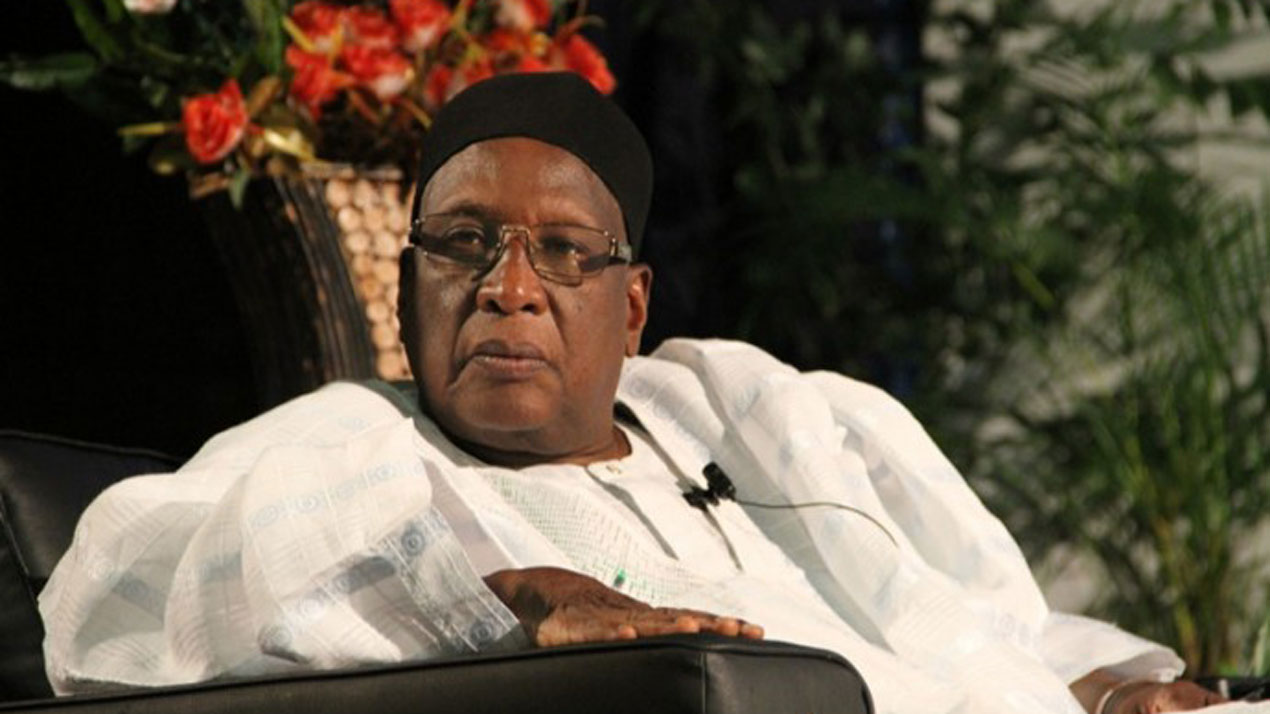
Former National Chairman of the Peoples Democratic Party (PDP), Alhaji Bamanga Mohammed Tukur, has died at 90, bringing to an end a public career that spanned business, politics, government and continental economic advocacy.
Tukur died on Saturday, September 12, 2026, according to a statement issued by his family.
His son, Hon. Awwal D. Tukur, who announced the death on behalf of the family, said arrangements were being made to transport his remains to Yola, Adamawa State, for burial.
The family described Tukur as a devoted father and patriarch whose life was defined by service to his family, community, Adamawa State and Nigeria.
It said details of the Janazah, or Islamic funeral prayer, would be announced later.
The family prayed for Allah to forgive his shortcomings, accept his good deeds and grant him Aljannatul Firdaus.
From Public Service to National Politics
Born on September 15, 1935, Tukur was just three days short of his 91st birthday when he died.
His career stretched across some of the most significant political and economic periods in Nigeria’s history.
He first established himself as a major public servant through the Nigerian Ports Authority (NPA), where he served as General Manager and Chief Executive from the mid-1970s into the early 1980s.
His time at the NPA coincided with an important phase in the expansion and development of Nigeria’s maritime infrastructure.
Tukur later moved into electoral politics and became governor of the old Gongola State, an entity that was subsequently divided into present-day Adamawa and Taraba states.
He assumed office in October 1983 on the platform of the then National Party of Nigeria (NPN).
His tenure, however, was brief.
The military coup of December 31, 1983, which brought the Second Republic to an abrupt end, removed him from office after roughly three months.
A Return to Presidential Politics
Tukur returned to the political arena during the transition programme launched by military President Ibrahim Babangida.
He sought the presidency under the National Republican Convention (NRC) during the ultimately aborted transition to the Third Republic.
Although that presidential bid did not result in his emergence as Nigeria’s leader, Tukur continued to build an influential career spanning government, politics and business.
During the military administration of General Sani Abacha in the 1990s, he served as Minister of Industries, adding a federal cabinet position to his previous experience as governor and NPA chief.
Building an African Business Profile
Tukur’s influence extended well beyond government.
Through his business interests associated with the DADDO Group, he developed a substantial private-sector profile and became an advocate for greater African participation in economic development.
He served as Executive President of the African Business Roundtable and chaired the NEPAD Business Group, where he worked at the intersection of business, investment and policymaking.
His international roles also included leadership positions in the maritime and cargo-handling sectors.
Among them were Vice Chairman of the International Ports and Harbours Association and Chairman of the International Cargo Handling Association.
These positions gave him a platform to engage with business leaders, investors and policymakers beyond Nigeria.
Turbulent Years as PDP Chairman
Tukur later became a major figure in Nigeria’s ruling political establishment.
In March 2012, he was elected National Chairman of the PDP during the administration of former President Goodluck Jonathan.
His tenure came during one of the party’s most difficult periods.
The PDP was increasingly divided, culminating in the 2013 rebellion that produced the faction popularly known as the “New PDP” and involved several governors and senior party figures.
Tukur eventually resigned as national chairman in January 2014.
Later that year, the Jonathan administration appointed him Ambassador-at-Large.
A Legacy Across Generations
Beyond his political and professional positions, Tukur was also a traditional title holder, serving as Tafidan Adamawa and Wakilin Ganye.
He was also a recipient of the Commander of the Order of the Niger (CON).
In a tribute marking Tukur’s 88th birthday in 2023, President Bola Tinubu highlighted his long record across Nigeria’s public and private sectors, including his service as governor, NPA chief, Minister of Industries, PDP chairman and African business leader.
Tukur’s death marks the passing of a political figure whose career crossed several eras—from the early decades of Nigeria’s post-independence public service and the Second Republic to the aborted Third Republic and the Fourth Republic.
He leaves behind a legacy shaped not by a single office, but by more than half a century of involvement in Nigeria’s political, economic and public life.