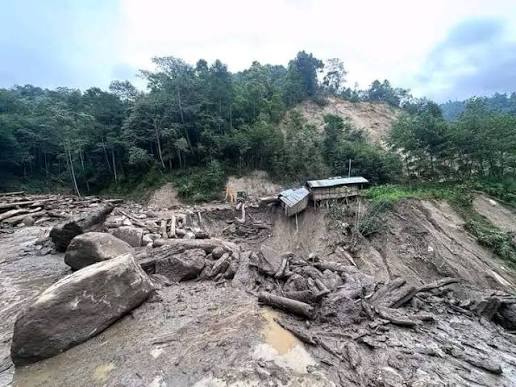
At least 347 people were displaced by flooding and a mudslide in Cross River in August, exposing the growing disaster risks facing communities across the state.
The figure was disclosed by the Cross River State Emergency Management Agency (CR-SEMA), which said 167 people were left homeless after a mudslide in Calabar, while about 180 internally displaced persons (IDPs) were affected by heavy rainfall in the Central Senatorial District.
According to CR-SEMA Director-General Efa Nyong, the affected residents are currently being accommodated at different locations in Calabar and parts of the Central Senatorial District.
Speaking to journalists in Calabar, Nyong said the recent incidents highlighted the need for communities to take disaster prevention and preparedness more seriously.
What caused the displacement in Cross River?
Nyong said the disasters affecting the state were linked to both natural events and human activities.
“Basically, two things are happening,” he said, pointing to natural occurrences as well as activities carried out by residents.
The agency’s response has included visits to communities in the Southern and Central Senatorial Districts to educate residents on ways to reduce disaster risks.
Nyong, who assumed office on July 14, said the sensitisation campaign would soon move to the Northern Senatorial District.
After completing the district-level campaign, SEMA plans to launch a statewide advocacy programme using billboards, radio advertisements and town criers to reach residents with disaster-prevention messages.
SEMA warns against indiscriminate waste disposal
One of the agency’s major concerns is the improper disposal of refuse.
Nyong warned that dumping waste indiscriminately can create consequences far beyond the location where the waste was originally discarded.
He explained that the effects may not be immediately visible at the dumping site but could emerge several kilometres away, potentially contributing to problems during heavy rainfall.
The warning comes as the state continues to deal with flooding and other weather-related emergencies.
Residents urged to prevent electrical fires
SEMA also urged residents and businesses to take precautions against fire outbreaks, particularly those linked to electrical faults.
Nyong advised households to:
- Switch off electrical appliances when they are not in use.
- Replace faulty bulbs, cables and other electrical components promptly.
- Upgrade electrical wiring where necessary.
- Ensure that cables are capable of safely handling the electrical load placed on them.
These measures, he said, could help reduce avoidable fire incidents in homes and businesses.
How Cross River responds to disasters
Nyong said disaster management in Cross River follows a coordinated response structure that begins at the local government level.
The Local Emergency Management Committee (LEMC) serves as the first point of response, with the vice-chairman of each local government coordinating emergency activities at the community level.
When an incident exceeds the capacity of the local response structure, the matter is escalated to CR-SEMA.
If the state agency is also unable to manage the emergency with its available resources, assistance can then be sought from the National Emergency Management Agency (NEMA).
Nyong said international assistance could become necessary when an emergency goes beyond NEMA’s capacity.
The Nigerian Red Cross Society is also a key partner in the response, particularly when displaced residents need temporary accommodation and other forms of support.
Relief efforts continue for displaced residents
SEMA is providing shelter for some victims at its office, while others are being accommodated through Red Cross facilities.
The agency has also received relief materials from individuals and private organisations. The state government has provided additional relief materials and financial assistance to people affected by the disasters.
Nyong said the immediate priority was to help affected residents regain stability.
The longer-term goal is to help them return to their communities where possible or find alternative accommodation if returning home is not feasible.
Why disaster damage is difficult to quantify
Nyong said the agency could not put a fixed monetary value on the damage caused by recent disasters.
He explained that the cost of rebuilding damaged homes, businesses and infrastructure changes with prevailing economic conditions, making it difficult to establish a reliable figure.
Rather than assigning a potentially inaccurate amount, the agency is focusing on supporting victims and helping restore their livelihoods.
Prevention remains critical as disaster risks grow
The displacement of 347 people in August has reinforced the importance of preparedness in communities vulnerable to flooding and other disasters.
For SEMA, response is only one part of disaster management. Public awareness, responsible waste disposal, electrical safety and community preparedness are also essential to reducing the impact of emergencies.
As the agency expands its sensitisation campaign across Cross River, residents are being urged to take preventive measures seriously—not only after disaster strikes, but before it happens.
Cross River flooding and mudslides have displaced hundreds of residents, but SEMA’s message is clear: stronger preparedness and safer community practices can help reduce the human cost of future disasters.