
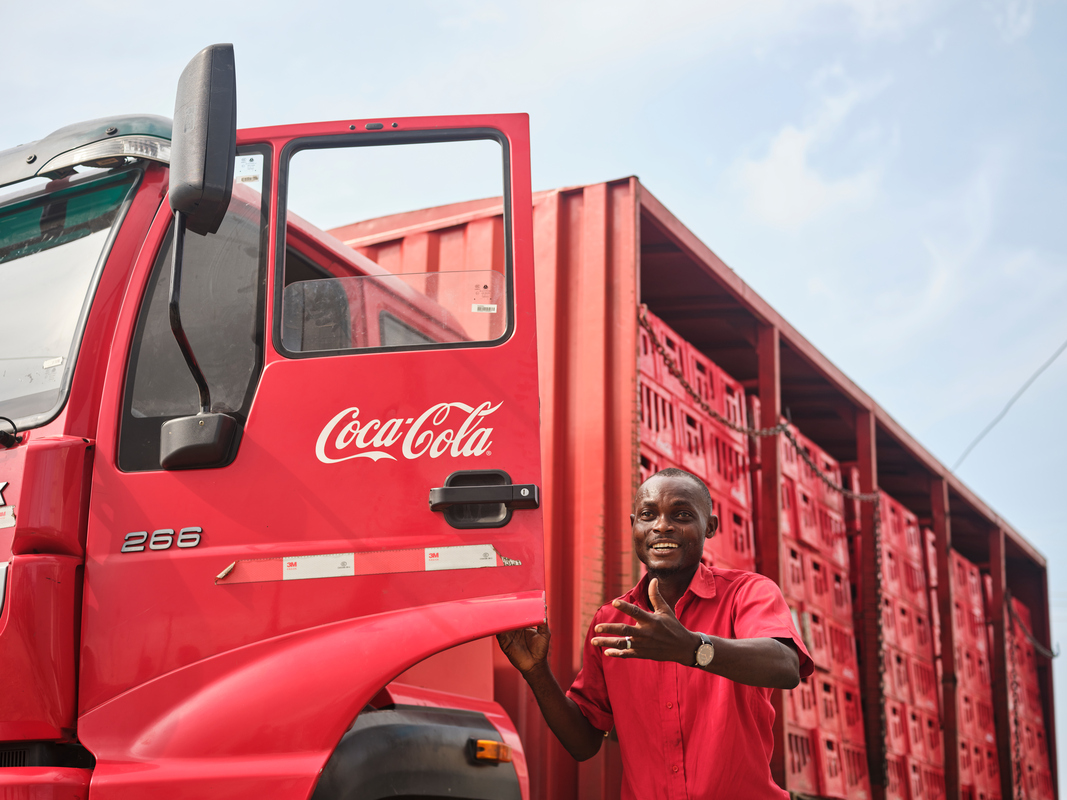
Coca-Cola’s operations in Nigeria supported more than 160,000 jobs and generated an estimated $1 billion in economic value in 2024, highlighting the wider impact of the beverage giant’s supply chain on the country’s economy.
The figures are contained in a new Socio-Economic Impact Assessment conducted by global consultancy Steward Redqueen, which examined the contribution of the Coca-Cola System to Nigeria’s economy.
The assessment covers Coca-Cola Nigeria Limited and its authorised bottling partner, Nigerian Bottling Company, and looks beyond the companies’ direct workforce to measure the broader economic activity generated through suppliers, distributors, retailers and other businesses connected to their operations.
Using the Leontief input-output economic model, the study found that the Coca-Cola System supported approximately 160,200 jobs across Nigeria in 2024.
Only a small proportion of those positions were direct jobs within the companies themselves, demonstrating the scale of the economic activity generated throughout the wider value chain.
Coca-Cola Supported More Than 157,000 Indirect Jobs
According to the assessment, the Coca-Cola System directly employed approximately 2,989 people during the period examined.
Its wider operations, however, supported more than 157,200 additional jobs across sectors including agriculture, logistics, retail, hospitality and distribution.
The study calculated that for every job created directly by the Coca-Cola System, another 53 jobs were supported elsewhere in the Nigerian economy.
That multiplier effect reflects the interconnected nature of large-scale manufacturing and consumer businesses.
From farmers and packaging suppliers to transport operators, distributors, retailers and waste collectors, a beverage company’s operations can create economic activity far beyond its own factories and offices.
The findings suggest that Coca-Cola’s presence in Nigeria has become closely linked with a broad network of local businesses and workers.
Local Suppliers Receive $601 Million in Annual Spending
Another major finding from the assessment was the scale of Coca-Cola’s domestic procurement.
The company reportedly spends approximately $601 million annually on goods and services sourced from local suppliers.
A significant share of the ingredients, packaging materials and other inputs required for production is sourced, manufactured or distributed within Nigeria.
That local sourcing strategy means Coca-Cola’s economic footprint extends into several areas of the Nigerian economy.
Agricultural producers can benefit from demand for locally sourced inputs, while manufacturers and logistics companies participate in supplying and moving materials and finished products.
Retailers and distributors also form an important part of the chain through which Coca-Cola products reach consumers across the country.
The study said this integration has helped deepen the company’s links with Nigeria’s agriculture, manufacturing and logistics sectors while creating opportunities for businesses of different sizes.
The Economic Impact Extends Beyond Beverage Manufacturing
The report’s findings highlight a broader issue in assessing the contribution of multinational companies to an economy.
Direct employment and corporate operations provide only part of the picture.
The companies that supply raw materials, packaging, transportation, warehousing and other services can also experience increased demand as a result of large-scale industrial activity.
In Coca-Cola’s case, the assessment suggests that this network effect is particularly significant because of the size and reach of its Nigerian operations.
The resulting economic activity contributes to employment and income across multiple sectors rather than being concentrated within the company’s own workforce.
This helps explain how fewer than 3,000 direct employees can be associated with an estimated 160,200 jobs supported across the wider economy.
Coca-Cola Expands Investment in Waste Management
The company’s reported economic contribution also extends into environmental initiatives.
The assessment highlighted Coca-Cola’s investment in waste management and recycling, including the launch of a packaging collection hub in Apapa, Lagos.
The facility has the capacity to process approximately 13,000 metric tonnes of PET plastic annually.
It is also expected to support about 1,000 informal waste collectors, connecting environmental management with income-generating opportunities.
The facility is intended to strengthen Nigeria’s recycling ecosystem by improving the collection and recovery of used plastic packaging.
For a country facing persistent challenges around plastic waste management, initiatives that connect formal recycling infrastructure with informal waste collectors can play an important role in improving recovery rates while supporting livelihoods.
$25 Million Water Stewardship Initiative Reaches Nigeria
Water sustainability is another area highlighted in the assessment.
The Coca-Cola System has committed $25 million to an Africa-wide water stewardship initiative covering 20 markets, including Nigeria.
Projects implemented under the initiative have reached communities in Borno and Imo states, where activities have included borehole rehabilitation, sanitation infrastructure and riverbank restoration.
According to the assessment, more than 2.6 million people have been impacted by the water-related projects.
The initiatives are aimed at addressing water access and environmental sustainability while improving conditions in communities where the programmes operate.
The focus on water is particularly relevant to beverage manufacturing, where responsible management of water resources is an important part of long-term operational sustainability.
From Jobs to Environmental Sustainability
Taken together, the findings present the Coca-Cola System’s contribution as broader than beverage production.
The assessment identifies four major areas of impact: employment, local procurement, environmental sustainability and community development.
Employment is supported directly through the company’s workforce and indirectly through its supply chain.
Local procurement creates demand for Nigerian suppliers and businesses.
Recycling initiatives contribute to waste management while supporting people involved in collection and recovery.
Water stewardship programmes, meanwhile, seek to improve access to water and protect environmental resources in communities.
The combination illustrates how the operations of a large consumer company can intersect with multiple parts of the economy.
Coca-Cola Plans Another $1 Billion Investment
The latest assessment comes as Coca-Cola has previously announced plans to invest an additional $1 billion in Nigeria over the next five years.
The planned investment is conditional on the availability of what the company describes as a predictable and enabling policy environment.
If implemented, the additional capital would further increase the company’s footprint in Nigeria and could create additional activity across manufacturing, supply chains, distribution and related industries.
It also places greater emphasis on the policy environment in which major businesses operate.
For large manufacturers, factors such as regulatory certainty, infrastructure, energy availability, foreign exchange conditions and consumer demand can influence investment decisions and the pace at which new capital is deployed.
What Coca-Cola’s Economic Footprint Means for Nigeria
The findings from Steward Redqueen offer a picture of a business whose economic footprint is considerably larger than its direct workforce.
The estimated 160,200 jobs supported and $1 billion in value-added economic activity demonstrate how manufacturing and consumer brands can generate economic effects through extensive networks of suppliers, distributors and service providers.
The reported $601 million in annual local procurement further underscores the importance of domestic supply chains in translating corporate operations into broader economic activity.
At the same time, Coca-Cola’s investments in recycling and water stewardship suggest that the company’s impact is increasingly being measured not only by production and sales but also by its environmental and community programmes.
As Nigeria seeks to attract investment, expand local manufacturing and create more employment opportunities, the ability of major companies to build deeper connections with domestic suppliers and communities will remain important.
For Coca-Cola, the next phase will depend on how effectively it can build on its existing footprint, expand local value creation and deliver on its proposed $1 billion additional investment.
For Nigeria, the larger question is how investments of this scale can translate into stronger local supply chains, more jobs, greater industrial capacity and sustainable economic opportunities across the country.