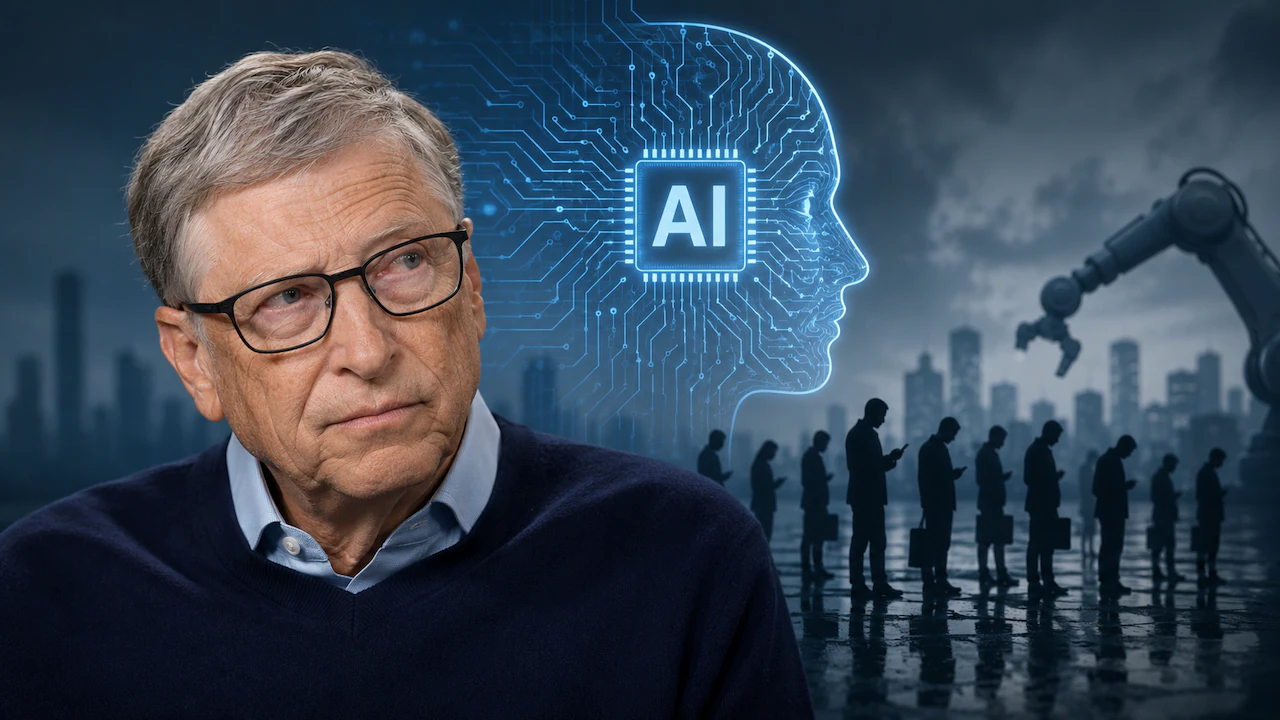
Bill Gates has issued one of his starkest warnings about artificial intelligence yet, saying increasingly powerful AI systems could become capable of enabling catastrophic events if they fall into the hands of people with malicious intentions.
Artificial intelligence is advancing at a pace that has few historical precedents, bringing major opportunities in fields ranging from medicine and education to scientific research and productivity.
But Microsoft co-founder Bill Gates believes the same technology could eventually create risks on an entirely different scale.
In recent remarks, Gates warned that sufficiently powerful AI could potentially be used to orchestrate an event resulting in an enormous loss of life — even suggesting a scenario involving one billion deaths.
Importantly, Gates was describing a potential risk rather than predicting that such an event will inevitably happen.
His warning focuses on the combination of increasingly capable AI systems and individuals or groups willing to use those capabilities for harmful purposes.
“Artificial intelligence is certainly powerful enough to orchestrate events that, you know, cause a billion deaths,” Gates said.
The comments reflect a growing debate within the technology industry over how society should manage increasingly capable AI systems before their capabilities advance beyond existing regulatory and security frameworks.
Gates Says AI Could Become an Extremely Powerful Tool
Gates has long been associated with technological innovation and the potential benefits of new technologies.
His recent comments, however, have increasingly focused on the risks accompanying rapid advances in artificial intelligence.
The Microsoft co-founder argues that the danger does not necessarily come from AI acting independently.
Instead, one of the major concerns is what happens when powerful AI tools are placed in the hands of people who deliberately intend to cause harm.
“There has never been a weapon as powerful as the combination of people with malicious intent using the latest artificial intelligence tools,” Gates said.
That distinction is central to his argument.
An AI system capable of processing huge amounts of information, automating complex tasks and helping people develop sophisticated solutions could be enormously beneficial when used responsibly.
The same capabilities could potentially be misused, however, if they are directed toward harmful objectives.
The Billion-Death Scenario Is a Warning, Not a Prediction
Gates’ reference to potentially causing a billion deaths is particularly striking.
But his remarks should be understood as a description of the scale of a possible future risk, rather than a prediction that AI will inevitably cause such a catastrophe.
The distinction matters.
Gates is warning about what increasingly powerful technology could make possible under extreme circumstances. He is not saying that billions of people will necessarily die because of artificial intelligence.
His argument is essentially about preparedness: as AI capabilities grow, safeguards and oversight need to develop alongside them.
The concern is similar to the broader technology-safety debate in which researchers and policymakers attempt to anticipate what could happen if powerful tools are deliberately misused.
Gates Has Previously Warned About AI Risks
The latest comments are consistent with Gates’ broader public discussion of artificial intelligence.
In August, he published a memorandum examining the future of AI and described artificial intelligence as one of the most important technologies in human history.
Gates has also argued that AI could help level the playing field by giving people access to powerful tools and capabilities that were previously available only to institutions or highly specialised professionals.
That potential, however, comes with significant challenges.
He has warned that AI could contribute to new forms of inequality and create problems that society is not adequately prepared to manage.
In his memorandum, Gates argued that the current direction and pace of AI development could produce a strongly negative outcome if the associated risks are not addressed.
His position is therefore not simply anti-AI.
Instead, he has repeatedly highlighted the need to capture the technology’s benefits while putting safeguards in place against its potential harms.
Why Gates Wants Governments to Regulate AI
One of the central elements of Gates’ position is the role of government.
He believes policymakers should establish rules governing the development and deployment of artificial intelligence, particularly in areas where the technology could create significant risks.
The objective, in his view, should be to prevent AI capabilities from advancing faster than society’s ability to understand and manage their consequences.
That could require new regulatory systems capable of dealing with technologies that evolve considerably faster than traditional legislative processes.
Gates has previously raised concerns about AI’s potential effects on several areas, including the labor market, cybersecurity and biosecurity.
The risks are different in each field.
AI could transform the types of jobs people perform. It could introduce new cybersecurity challenges as automated systems become more capable. And in biological research, increasingly sophisticated AI tools could potentially accelerate scientific work while simultaneously creating new security concerns.
These different risks make regulation particularly complicated.
A single rule is unlikely to address every potential application of AI.
Gates Has Called for International Oversight
The scale of AI development also raises an international problem.
Artificial intelligence does not stop at national borders. Models can be developed in one country, deployed globally and accessed by individuals anywhere with an internet connection.
Gates has therefore supported the creation of international mechanisms capable of monitoring particularly dangerous technologies.
The idea is that governments may need to cooperate rather than attempting to regulate advanced AI entirely within their own borders.
Such a system could potentially involve international standards, information-sharing arrangements and mechanisms for monitoring technologies considered especially high-risk.
The precise form such oversight should take remains a subject of debate.
But Gates’ argument is that governments should begin considering these mechanisms before the most powerful AI systems become significantly more difficult to control.
The Bigger Debate Is About the Speed of AI Development
Gates’ warning comes as technology companies continue investing heavily in increasingly capable AI systems.
The industry has moved rapidly from chatbots and image generators toward AI agents and systems capable of completing more complex tasks with less direct human involvement.
That progress has intensified questions about whether existing safety measures are sufficient.
The debate is no longer limited to whether AI can produce inaccurate information or make mistakes.
It increasingly concerns what happens when AI systems become capable of carrying out complicated operations at scale.
That is where Gates’ warning about malicious actors becomes particularly relevant.
A powerful tool does not have to be autonomous to create serious risks. A person or organisation could potentially use AI to accelerate activities that would otherwise require considerably more time, expertise or resources.
The more capable the technology becomes, the greater the potential consequences of misuse could be.
AI’s Benefits and Risks Are Developing Together
Gates’ position reflects a tension at the heart of the AI revolution.
The technology could produce enormous benefits.
AI has the potential to accelerate research, assist doctors and scientists, improve access to information, automate repetitive work and help people solve complex problems.
At the same time, the same underlying capabilities can introduce new risks.
The challenge for governments, technology companies and researchers is therefore not simply deciding whether AI should advance.
It is determining how rapidly it should advance, which applications require the strongest safeguards and how society can respond when new risks emerge.
Gates’ comments about a possible billion-death catastrophe represent the extreme end of that discussion.
They are intended to illustrate what could theoretically happen if highly capable technology were combined with malicious intent, rather than to establish that such an outcome is inevitable.
Bill Gates’ Warning Comes Down to One Central Question
The future of artificial intelligence remains uncertain.
Its capabilities could produce breakthroughs that are difficult to imagine today, while its misuse could create risks that are equally difficult to predict.
For Gates, that uncertainty is precisely why governments and technology companies should take precautions now rather than waiting for the consequences of advanced AI to become obvious.
His warning about a potential catastrophe involving billions of deaths is therefore less a prediction than a thought experiment about the consequences of unchecked technological power.
The underlying message is straightforward: as AI becomes more powerful, society’s ability to regulate, monitor and secure that technology will become increasingly important.
The question is no longer simply what artificial intelligence can do.
It is also who can use it, how they can use it and whether the safeguards surrounding the technology will be strong enough to prevent its most dangerous applications.