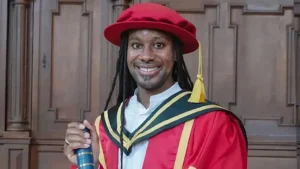
Nigerian poet Ogaga Ifowodo has won The Nigeria Prize for Literature 2026, taking home the prestigious $100,000 award for his poetry collection, Why Does God Need a Gun?, a work that confronts the devastating effects of religious and political violence in Nigeria.
The announcement was made at the Grand Award Night organised by Nigeria LNG Limited (NLNG) in Lagos on Friday, October 9, 2026, where winners of two major cultural awards were also celebrated.
In another highlight of the ceremony, Beyond Tarkwa Bay, directed by Peter Oghenetega Oke, and Mara Mania, by Feranmi Abiola, emerged as joint winners of the inaugural Nigeria Prize for Creative Arts. The two documentaries will share the recognition attached to the new award, which carries a total cash prize of $20,000.
The awards celebrated outstanding achievements in poetry, documentary filmmaking and creative expression, bringing together writers, filmmakers, scientists and other prominent figures to recognise work that explores Nigeria’s experiences while contributing to broader conversations about humanity.
Ifowodo’s victory came from a competitive field of 223 entries, while the two winning documentaries were selected from 98 submissions for the Creative Arts Prize.
Beyond the cash awards, the ceremony highlighted the role of literature, film and scientific innovation in examining society’s challenges, preserving cultural memory and developing ideas that can improve lives.
Ogaga Ifowodo’s Why Does God Need a Gun? Wins Top Literary Honour
Ifowodo’s winning collection, Why Does God Need a Gun?, was recognised for its sensitive examination of religious and political violence in Nigeria.
Announcing the winner, Professor Akachi Adimora-Ezeigbo, chairman of the Advisory Board for The Nigeria Prize for Literature, described the collection as a compelling portrayal of violence narrated through the voice of an imagined victim.
The work’s central themes reflect the human consequences of conflict and the ways political and religious violence can shape individual lives and communities.
By approaching these issues through poetry, the collection brings a personal dimension to experiences that are often discussed primarily in political or historical terms.
Adimora-Ezeigbo also praised the three shortlisted poetry collections for their technical accomplishment, confident expression and mature command of language.
She noted that the works explored concerns that extend beyond Nigeria’s borders, demonstrating how literary experiences rooted in a particular national context can speak to wider questions about identity, belonging and the human condition.
The shortlisted collections examined interconnected themes, including the promises and disappointments of nationhood, the consequences of extremism, displacement and the lasting effects of conflict.
Although the works differed in their voices and artistic approaches, the advisory board chairman said they were grounded in Nigerian experiences while contributing to global discussions about humanity.
Ifowodo’s win therefore represents both individual literary recognition and an acknowledgement of poetry’s capacity to engage with difficult social and political realities.
Beyond Tarkwa Bay and Mara Mania Share Creative Arts Prize
The Grand Award Night also marked the introduction of the Nigeria Prize for Creative Arts, with documentary filmmakers Peter Oghenetega Oke and Feranmi Abiola emerging as the inaugural joint winners.
Oke’s Beyond Tarkwa Bay and Abiola’s Mara Mania were selected from 98 submissions, securing recognition under the new award, which carries a $20,000 cash prize.
The establishment of the Creative Arts Prize expands NLNG’s awards programme beyond literature and scientific innovation, creating another platform for recognising original work that engages with Nigerian society and culture.
Speaking about the shortlisted documentaries, Joel Kachi Benson, technical adviser to the Creative Arts Prize Advisory Board, commended all five films for challenging existing perceptions and encouraging audiences to connect with communities and experiences that frequently receive limited attention.
He said the documentaries helped bring overlooked stories into public view and amplified voices that might otherwise remain unheard.
According to Benson, the films served several important purposes: celebrating resilience, documenting cultural experiences, preserving collective memory and offering perspectives that deepen society’s understanding of itself.
Documentary filmmaking can provide a record of communities, traditions and lived experiences while encouraging viewers to reconsider assumptions about the people and places depicted on screen.
The recognition of Beyond Tarkwa Bay and Mara Mania underscores the importance of such storytelling and signals NLNG’s intention to support creative work that contributes to cultural preservation and public understanding.
Nigeria Prize for Science and Innovation Recognises AI-Powered Healthcare Solution
The literary and creative arts awards followed an earlier announcement in September 2026, when Mary-Brenda Akoda was named the winner of The Nigeria Prize for Science and Innovation.
Akoda won for GenScan AI (GenMRI/C-MORE), an artificial intelligence-powered innovation designed to accelerate magnetic resonance imaging (MRI).
Her achievement marked two milestones in the prize’s history. She became its first Generation Z recipient and the first woman to win as an individual awardee.
The innovation highlights the growing role of artificial intelligence and information technology in addressing practical challenges, particularly in healthcare.
MRI is an important medical imaging technique, and a solution designed to accelerate the process has the potential to contribute to more efficient healthcare delivery.
At the awards ceremony, NLNG Managing Director and Chief Executive Officer Adeleye Falade highlighted the importance of the science and innovation prize in recognising contributions across sectors such as healthcare, agriculture, engineering, energy, technology, climate resilience and sustainable development.
He emphasised that the award had recognised scientists whose work goes beyond laboratory research and academic publications to develop practical solutions with the potential to improve people’s lives.
Falade also said this year’s winning innovation, which focuses on artificial intelligence and information technology, could have an impact in Nigeria and beyond.
Akoda’s achievement illustrates the prize’s emphasis on innovation that addresses real-world needs while opening opportunities for emerging researchers and technology professionals.
NLNG Says Nigeria Prizes Are Driving Excellence Across Multiple Fields
Falade used the ceremony to reaffirm NLNG’s commitment to supporting scientific discovery, literary achievement and creative expression.
He described the Nigeria Prizes as platforms established to recognise exceptional work and encourage achievements that enrich society and improve lives.
According to him, The Nigeria Prize for Literature has developed into one of Africa’s most prestigious literary honours, attracting substantial interest and providing a platform for some of the continent’s leading literary voices.
He said Nigerian writers had used the recognition associated with the award to demonstrate that their stories could contribute to international conversations about identity, resilience and shared humanity.
The Creative Arts Prize, meanwhile, was presented as an opportunity to celebrate originality, authenticity and artistic excellence, particularly among creators who preserve Nigeria’s cultural heritage while reinterpreting it for younger generations.
Falade said the three prizes had become enduring national institutions, demonstrating the value of recognising and rewarding excellence across different disciplines.
Congratulating the winners and finalists, he praised their discipline, commitment and perseverance, expressing hope that their achievements would inspire a new generation of scientists, writers and creative professionals.
He encouraged emerging talents to develop solutions to future challenges, tell meaningful stories and contribute to shaping Nigeria’s future.
Wole Soyinka Calls for Stronger Collaboration Between Science and the Humanities
Nobel laureate Professor Wole Soyinka delivered a broader message at the ceremony, urging closer collaboration between the sciences and the humanities.
Soyinka argued that imagination should not be viewed as the exclusive preserve of writers, poets and artists. Instead, he described it as a fundamental element of scientific inquiry, including disciplines such as mathematics and physics.
In his view, both scientific discovery and artistic creation depend on the ability to envision possibilities beyond what is already known.
He called on practitioners across the two fields to work together, combine their strengths and expand the boundaries of human imagination.
The Nobel laureate also stressed that human wellbeing must remain central to both creative expression and scientific advancement.
His remarks offered a unifying theme for an evening that celebrated achievements across poetry, filmmaking and technological innovation.
While the three disciplines employ different methods, each can contribute to a deeper understanding of society, the challenges people face and the possibilities for creating a better future.
Nigeria Prizes Celebrate Literature, Creativity and Innovation
The 2026 awards have brought renewed attention to the contributions of Nigerian talent across several fields.
Ifowodo’s $100,000 literary victory recognises poetry that confronts difficult questions about violence and humanity. The joint Creative Arts Prize winners have been acknowledged for documentary storytelling that brings overlooked experiences and communities into focus. Akoda’s science and innovation award highlights the potential of artificial intelligence to address practical challenges.
Together, the achievements reflect the broad scope of the Nigeria Prizes and their shared emphasis on work that extends beyond individual accomplishment.
For NLNG, the awards also serve as an investment in the country’s intellectual, cultural and technological future.
The company said the prizes reaffirm its commitment to recognising excellence and encouraging achievements that can contribute to a sustainable future.
As the awards continue to bring scientists, writers and creative professionals into the spotlight, the message from the 2026 ceremony was clear: Nigeria’s future depends not only on technological progress, but also on the power of stories, ideas and imagination to help society understand itself and move forward.