
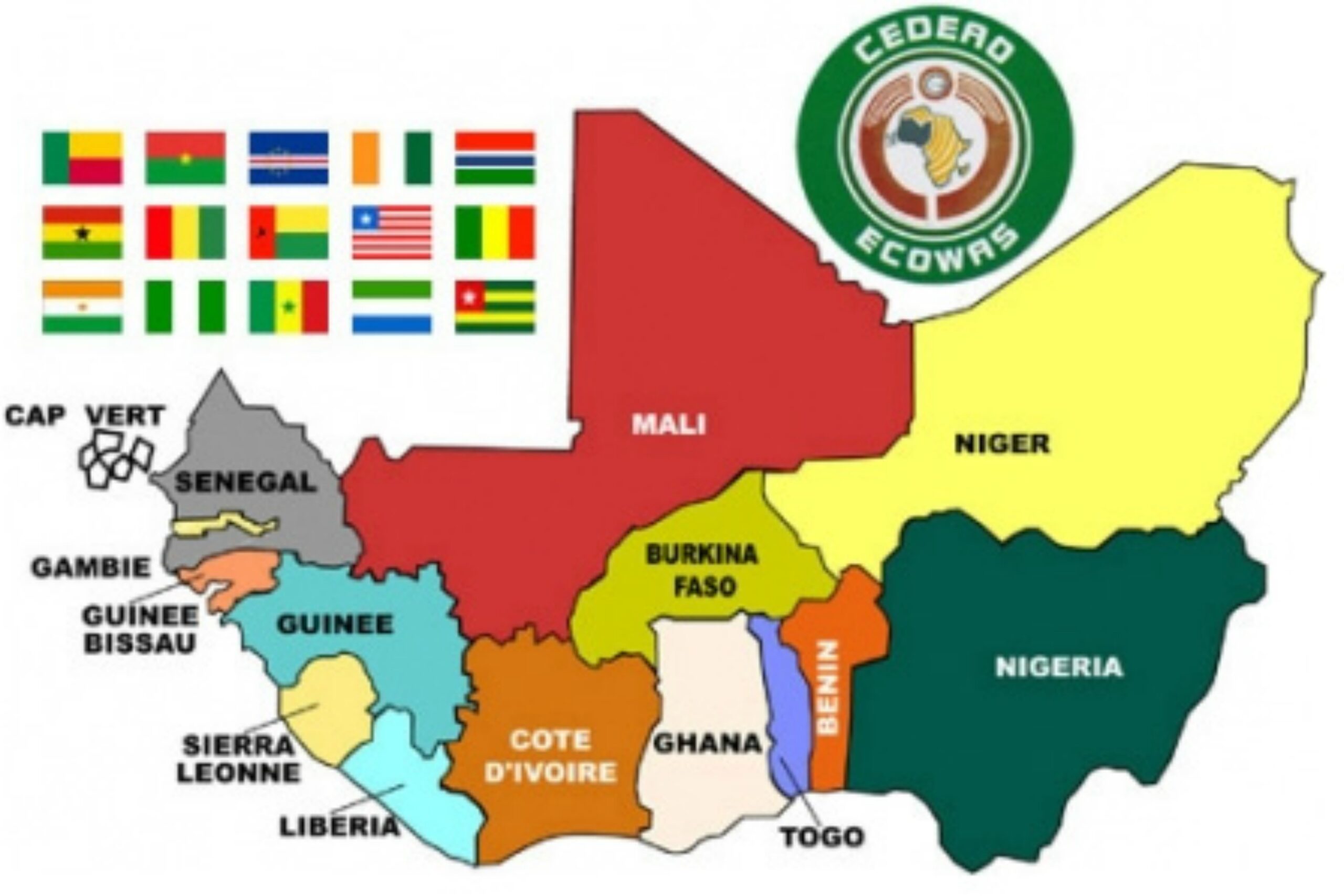
ECOWAS is facing a defining test: rebuild regional unity or watch West African integration fracture further.
New Commission President General Birame Diop has made reconciliation with Burkina Faso, Mali and Niger one of his immediate priorities, arguing that geography, shared security threats and economic ties make lasting separation unrealistic.
Diop made the remarks in Abuja on Monday during the formal transfer of leadership from outgoing Commission President Dr Omar Alieu Touray.
His arrival comes at a difficult moment for the regional bloc. The three Sahelian countries withdrew from ECOWAS after prolonged disputes over military rule, sanctions and the organisation’s insistence on constitutional governance.
But Diop’s message was clear: political disagreements cannot erase the realities that bind West Africa together.
‘We Have No Other Choice’
Diop pointed to the extensive borders shared by ECOWAS members and the Alliance of Sahel States (AES), noting that people and commerce continue to cross them despite the political split.
The challenges facing the region are equally difficult to contain within national boundaries.
Terrorism, organised crime, irregular migration and environmental pressures affect communities on both sides of the divide.
For Diop, that makes renewed cooperation a necessity rather than a choice.
He said ECOWAS must pursue a more coordinated relationship with the three countries for the benefit of people across both regional groupings.
ECOWAS ‘At a Crossroads’
The new president also acknowledged the internal pressures facing the organisation.
He described ECOWAS as being at a crossroads and called for member states and institutions to rebuild trust in the regional integration project.
His administration, he said, must function as a cohesive team rather than a collection of competing interests.
That means focusing on:
- Stronger institutional cohesion
- Greater operational efficiency
- New approaches to financing
- Implementation of existing regional programmes
- Closer cooperation on security and development
Diop said ECOWAS’s Vision 2050 would provide the strategic framework for those efforts, including the implementation of more than 50 programmes already developed by the organisation.
Nigeria Backs Greater Engagement
Nigeria signalled support for the push to reopen dialogue with the AES countries.
Speaking on behalf of President Bola Ahmed Tinubu, Minister of State for Foreign Affairs Ambassador Sola Enikanolaiye urged the new ECOWAS leadership to intensify engagement with Burkina Faso, Mali and Niger.
He described the three countries as neighbours facing many of the same challenges and aspirations as the rest of the region.
The message reflects Nigeria’s apparent preference for keeping the possibility of reconciliation alive despite the political disagreements that triggered the withdrawals.
Enikanolaiye also called for ECOWAS to become an organisation centred more directly on its citizens.
From Governments to Citizens
The minister argued that regional integration should be measured by what ordinary West Africans can actually experience.
That includes the ability to:
- cross borders with fewer obstacles;
- trade more easily across countries;
- find employment within the region;
- access opportunities for their families; and
- live in safer communities.
But Nigeria also wants stronger financial discipline from the bloc.
Enikanolaiye said Nigeria’s substantial contribution to ECOWAS—including payments through the community levy—must be matched by accountability, prudent spending and tighter controls against waste and operational leakages.
Guinea-Bissau Adds Another Challenge
Diop will also inherit an unresolved political problem in Guinea-Bissau.
He disclosed that ECOWAS leaders had chosen Senegal as facilitator after their recent meeting in Lungi.
The new Commission intends to work with Dakar to help find a solution to the crisis.
That adds another difficult item to an already crowded regional agenda.
Touray Defends His Record
As Diop took over, Touray defended the achievements of his four-year tenure.
He said his administration operated through a period marked by military takeovers, terrorism, violent extremism, humanitarian emergencies and economic pressure.
Among the projects and initiatives he highlighted were:
- the African Atlantic Gas Pipeline;
- the Abidjan-Lagos Corridor Highway;
- regional electricity interconnection projects;
- trade and transport corridors;
- preparations for the proposed ECO currency launch in 2027; and
- investment initiatives aimed at strengthening regional food production.
Touray said the West Africa Rice Investment Roundtable produced an investment pipeline worth approximately $1.54 billion, including about $1.47 billion in firm commitments.
He also pointed to the completion of the new ECOWAS headquarters complex in Abuja, supported by China, and a logistics depot in Sierra Leone intended to support regional peace and other operations.
The Hardest Legacy: The Sahel Split
Yet the most sensitive issue inherited by Diop may be the same one now at the centre of his agenda: the departure of Burkina Faso, Mali and Niger.
Touray said his administration had to manage the practical consequences of the withdrawals, including the closure and transfer of ECOWAS offices and assets in the three countries.
That process underscored how deeply the political dispute had disrupted the organisation’s established structures.
Now Diop faces the more difficult question: Can political separation be followed by practical reconciliation?
A Fight for the Future of Integration
Both the incoming and outgoing presidents returned to the same underlying principle: ECOWAS ultimately has to deliver tangible benefits to West Africans.
Touray argued that citizens do not experience regional integration through official communiqués. They experience it when borders become easier to cross, trade becomes simpler, opportunities expand and communities become more secure.
That may be the central challenge confronting Diop.
ECOWAS has lost three members. Its new leadership wants to reopen the door.
Whether that produces reconciliation—or merely another round of regional diplomacy—could determine the future shape of West African integration.