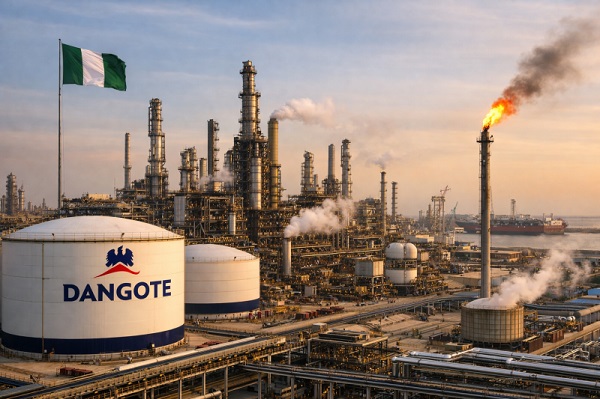
Could Dangote Refinery shares become a fivefold investment before the decade ends? Sujimoto Group Managing Director, Dr Sijibomi Ogundele, believes they could.
Ogundele has projected that shares of Dangote Petroleum Refinery and Petrochemicals could climb to as much as ₦5,000 before 2030, as he hailed the company’s planned ₦2.15 trillion initial public offering (IPO) as a potentially transformative moment for Nigerian investors.
But his bigger argument goes beyond the refinery.
For Ogundele, Nigeria does not need just another billionaire. It needs more industrial giants capable of turning capital into factories, jobs, exports and lasting economic value.
Dangote IPO Could Open Industrial Ownership to More Nigerians
The refinery is offering 4.1 billion shares at ₦525 each, with investors able to subscribe for a minimum of 10 shares.
That puts the minimum entry point at ₦5,250.
Ogundele said the relatively accessible minimum subscription could help change how Nigerians relate to large industrial companies by giving people across different income groups an opportunity to own a stake in a major enterprise.
He described the IPO as more than a financial transaction, arguing that wider ownership could allow ordinary Nigerians to participate in the company’s potential growth.
‘Dangote Is a Beast’ — But Not Because of His Wealth
Ogundele also revisited his first encounter with the Dangote Refinery project in Ibeju-Lekki about five years ago.
The scale of what he saw made such an impression that he later wrote an article titled “Dangote Is a Beast.”
He explained that the word was never intended to describe Dangote’s wealth.
“The word ‘Beast’ was never about capital. It was about vision, it was about audacity, and it was about scale.”
For Ogundele, the refinery demonstrates what can happen when an entrepreneur pursues an enormous industrial goal despite obstacles such as infrastructure constraints, escalating costs and foreign-exchange pressures.
Nigeria Needs 10 More ‘Dangotes’
Ogundele’s most ambitious call was for Nigeria to produce at least 10 more industrial champions.
He wants to see major businesses emerge across sectors capable of transforming the country’s productive capacity.
His vision includes:
- Steel — with a major industrial champion based in Kaduna.
- Pharmaceuticals — driven by large-scale businesses in Anambra.
- Agriculture — anchored by industrial players in Niger.
- Technology — led by globally competitive companies in Lagos.
- Manufacturing — strengthened by businesses in Aba and Nnewi.
- Housing and infrastructure — developed by major players across Nigeria’s geopolitical zones.
According to Ogundele, these companies could create jobs, strengthen domestic supply chains, expand exports, increase tax revenues and reduce the country’s dependence on imported products.
Wealthy Nigerians Aren’t Enough
Ogundele argued that Nigeria’s problem is not simply the absence of wealthy individuals.
The bigger gap, he said, is the shortage of businesses capable of transforming wealth into productive industrial capacity.
“Ten Dangotes therefore cannot mean ten more names on a billionaire list.”
What Nigeria needs, he argued, are entrepreneurs who can turn investment into factories, technology, exports, supply chains, apprenticeships, tax revenue and millions of productive jobs.
That distinction, he suggested, should shape the country’s approach to entrepreneurship and economic development.
‘Nigeria Needs Patient Capital’
Ogundele also called for stronger government and financial-sector support for businesses attempting to operate at industrial scale.
He proposed that authorities identify credible entrepreneurs in strategic sectors and support them with the infrastructure and financing required to expand.
Such support, he said, should come with measurable targets covering areas such as:
- Job creation
- Export growth
- Technology transfer
- Local sourcing
- Industrial output
He also highlighted the burden created by Nigeria’s high operating costs.
Local businesses, he argued, should not have to spend heavily providing infrastructure that ought to already be available while simultaneously trying to compete with companies operating in more developed markets.
Using a sporting analogy, he said:
“You cannot tie an entrepreneur’s legs together and then complain that he cannot run like Usain Bolt.”
The Refinery’s Story May Not End Here
Ogundele also pointed to Dangote’s continued expansion plans, including efforts linked to increasing refinery capacity and developing petrochemical operations.
He said that willingness to pursue the next major project even after completing an enormous refinery illustrates the importance of long-term thinking and sustained ambition.
For Ogundele, the Dangote example fits into a broader global pattern: industrialists can have an influence that extends far beyond their personal wealth when their businesses become engines of production and economic development.
He argued that Africa must move away from a model centred on exporting raw materials and importing finished products.
The alternative is to build industries that process African resources locally and capture more value at home.
Why the IPO Matters
The planned IPO could therefore have significance beyond its headline valuation.
Ogundele sees it as an opportunity to broaden participation in industrial wealth.
With a minimum subscription of 10 shares, the offering could potentially attract a broad range of investors—from young professionals and workers to entrepreneurs and high-net-worth individuals—subject to the offer’s terms and investment risks.
He also connected the development to President Bola Tinubu’s ambition of building a $1 trillion Nigerian economy.
His argument is that such a target cannot depend on a handful of established companies.
Nigeria would need many more businesses operating at massive scale.
From One Dangote to a New Generation
Ogundele said Dangote’s journey has reinforced his own belief that difficult business conditions should not automatically dictate the size of an entrepreneur’s ambition.
He pointed to Sujimoto’s own projects as part of his effort to pursue large-scale development despite the challenges of operating in Nigeria.
But ultimately, he believes Dangote’s most important contribution could extend beyond the refinery, its valuation or even the IPO.
It could be the ambition the project inspires in the next generation.
“The Dangote Refinery IPO may allow millions of Africans to own part of one extraordinary enterprise. The greater opportunity is for an entire generation to inherit his audacity.”
For Ogundele, that is the bigger prize: a Nigeria capable of producing industrial champions across multiple sectors, competing globally and creating wealth on a much larger scale.
His vision can be summed up in one line:
One Dangote today. Ten industrial champions tomorrow.