
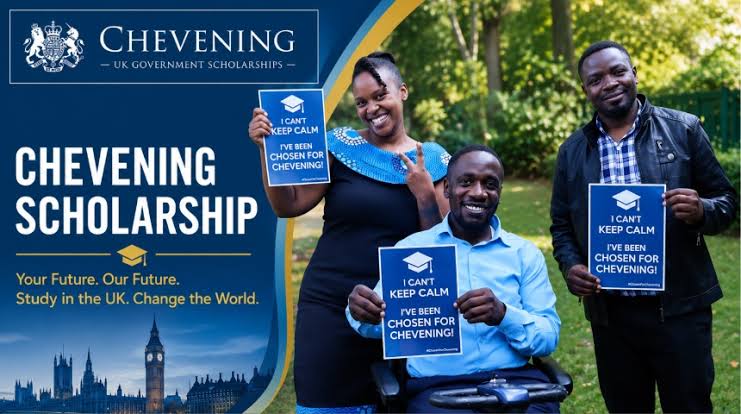
Chevening Scholarship: Why Every Ambitious Nigerian Graduate Should Consider Applying 2026
For many Nigerian graduates, the dream of studying abroad can feel like something reserved for people with wealthy parents, powerful connections, or the financial ability to pay international tuition fees.
But what if that assumption is wrong?
Table of Contents
What if your background does not have to determine the height of your ambition?
What if, despite being a middle-class Nigerian graduate, you could study for a master’s degree at a leading UK university, build relationships with people from around the world, develop your leadership capacity, and return home better equipped to create meaningful change?
This is where the Chevening Scholarship comes in.
Chevening is a UK Government-funded international scholarship programme that gives exceptional emerging leaders the opportunity to pursue a one-year master’s degree in the United Kingdom. The scholarship is fully funded, allowing successful scholars to concentrate on their studies, professional development and leadership journey.
For Nigerian graduates from middle-class families, Chevening is more than an opportunity to earn another degree. It can be a powerful bridge between where you are now and where your potential can take you.
You Don’t Have to Be Rich to Think Globally
One of the biggest barriers facing many Nigerian graduates is financial.
You may have graduated from university, gained work experience and developed a strong career ambition, but the cost of studying abroad can seem impossible. Tuition, accommodation, flights, visa expenses and living costs can quickly turn an international master’s degree into a distant dream.
This is why fully funded opportunities such as Chevening matter.
Chevening scholarships cover major costs associated with studying in the UK, including tuition fees and travel, alongside other components of the award.
This means that your family’s financial situation does not necessarily have to be the deciding factor in whether you can pursue an international education.
You don’t need to wait until you become wealthy.
You need to become prepared.
Your Background Is Not a Disqualification
There is sometimes an unspoken belief that prestigious international scholarships are meant for people who already have extraordinary connections or come from privileged backgrounds.
That mindset can prevent talented Nigerians from applying before they have even tried.
Chevening specifically states that there is no upper age limit for its scholarships and that factors such as class, gender, religion, marriage or parenthood do not determine eligibility. What matters is whether you can demonstrate the ability to succeed academically and articulate a clear vision for your future.
This is important for the Nigerian middle class.
Perhaps your parents worked hard to put you through university.
Perhaps you are supporting younger siblings.
Perhaps you are building your career without family connections in government, business or international organisations.
Perhaps you have had to work while developing professionally.
These experiences do not make your story less valuable.
They may actually help you understand the challenges you want to solve.
Chevening Is About More Than a Master’s Degree
If you think Chevening is simply a way to obtain a master’s degree abroad, you are thinking too small.
The academic qualification is only one part of the experience.
Chevening brings together emerging leaders from different countries and provides opportunities to build professional relationships with scholars, alumni, government representatives, speakers and partner organisations.
Imagine spending a year surrounded by people who are passionate about solving problems in healthcare, technology, education, agriculture, governance, climate change, finance, development and other fields.
Imagine discussing Nigeria’s challenges with people who understand similar challenges in Ghana, Kenya, India, Jamaica, Pakistan or other parts of the world.
Imagine discovering that a problem you have been trying to solve in your community has already been addressed somewhere else—and that you can learn from that experience.
That is the power of a global network.
The Network Can Change Your Career
For a middle-class Nigerian professional, access to the right network can be transformative.
Talent matters, but opportunities are often created through relationships, collaboration and exposure.
Chevening gives scholars the opportunity to develop relationships that can continue long after the master’s degree ends. Graduates become part of a global alumni community, with resources for networking, career development and impact.
This does not mean that every Chevening graduate will suddenly become successful.
Instead, it means you enter an environment where new possibilities become visible.
You meet people doing things you may never have imagined.
You learn how international organisations operate.
You encounter different approaches to leadership.
You become more confident communicating your ideas.
And sometimes, one conversation can lead to a collaboration, mentorship, opportunity or lifelong professional relationship.
You Will Return With More Than a Certificate
The real value of international education is not simply the certificate you bring home.
It is the person you become while earning it.
Studying in another country forces you to see your profession, your country and even yourself from a different perspective.
You encounter new systems.
You experience different approaches to problem-solving.
You learn to work with people from different cultures.
You are challenged to defend your ideas.
You develop independence.
And you begin to understand that Nigerian problems do not always require Nigerian-only solutions.
The goal is not to leave Nigeria and forget Nigeria.
In fact, Chevening’s model places significant emphasis on scholars returning to their home countries after their studies.
The bigger question becomes:
What will you do with what you have learned when you return?
Nigerian Chevening Alumni Are Already Making an Impact
You do not have to imagine what this opportunity could mean for Nigeria. There are already Nigerian Chevening scholars and alumni using their experiences to create change.
For example, Chevening alumna Samirah Bello returned to Nigeria after studying Globalisation, Business and Development at the University of Sussex. Within two years of graduating, she had helped build partnerships and mobilise millions of dollars in funding for projects supporting farmers and financial inclusion across Africa.
Another Nigerian alumna, Sarah Egbo, has worked to address sexual and gender-based violence within Nigerian higher education institutions after studying Gender and Development at the University of Sussex. Her Chevening network has also supported collaboration and professional growth.
These stories remind us of something important:
A scholarship becomes powerful when the person who receives it decides to use the opportunity for something bigger than themselves.
Your Middle-Class Story Can Be Your Strength
Maybe you grew up in a home where every major expense required careful planning.
Maybe your parents sacrificed to pay your school fees.
Maybe you have experienced the frustration of searching for jobs after graduation.
Maybe you have watched talented friends struggle because they lacked opportunities.
Maybe you have worked your way up without a powerful network.
Don’t be ashamed of that story.
Use it.
Your experiences can give you a deeper understanding of the problems facing ordinary Nigerians.
The challenge is to connect those experiences to a clear vision.
Chevening is looking for people with ambition, leadership qualities and a passion for creating positive change in their home countries.
So don’t ask only:
“Why should they give me a scholarship?”
Ask:
“What problem am I passionate about solving, and how will this opportunity help me solve it?”
That is a much more powerful question.
Don’t Disqualify Yourself Before Chevening Does
One of the biggest mistakes potential applicants make is deciding they are not qualified before they have carefully examined the requirements.
You may look at previous scholars and think:
“They are more accomplished than me.”
“They probably had better connections.”
“I don’t think someone like me can win.”
Stop.
Read the requirements.
Assess yourself honestly.
Identify your strengths.
Identify your weaknesses.
Improve where necessary.
Chevening generally requires applicants to have an undergraduate degree that qualifies them for postgraduate study in the UK, along with relevant work experience and other eligibility requirements. Eligible work experience can include full-time or part-time employment, voluntary work, and paid or unpaid internships.
And remember: Chevening scholarships are for one-year taught master’s programmes, not undergraduate degrees or PhDs.
The application process is competitive and demanding. That is precisely why preparation matters.
Don’t wait until applications open before you begin thinking about your story.
Start Preparing Before You Need To Apply
If you are a Nigerian graduate who hopes to apply for Chevening, start now.
Read about the scholarship.
Study the eligibility requirements.
Research master’s courses that align with your career goals.
Build meaningful professional experience.
Take on leadership responsibilities, even if they are small.
Volunteer.
Participate in community initiatives.
Document the problems you have helped solve.
Keep track of measurable results.
Develop your communication skills.
Build relationships with people in your professional field.
Most importantly, start thinking about your impact story.
Don’t simply collect certificates.
Collect experiences.
Don’t chase leadership titles.
Look for opportunities to solve problems.
Don’t try to sound impressive.
Become useful.
When you eventually sit down to write your application, you should be able to demonstrate not only what you have achieved but also why your future goals matter.
Your First Application Does Not Have to Be Your Last
Another important lesson is that rejection does not mean you are incapable.
Highly competitive scholarships attract talented applicants from around the world. Not being selected does not mean your dreams are too big.
It may simply mean your application needs improvement.
Perhaps your career goals were not clear enough.
Perhaps your leadership examples needed stronger evidence.
Perhaps you needed more professional experience.
Perhaps you did not communicate your story effectively.
Learn.
Improve.
Apply again when eligible.
The goal is not to become discouraged by competition.
The goal is to become competitive.
Nigeria Needs More Globally Exposed Leaders
Nigeria is full of intelligent and ambitious young people.
But talent without opportunity can become frustration.
And opportunity without responsibility can become self-interest.
What Nigeria needs is a generation of professionals who can combine knowledge, leadership, global exposure and a commitment to home.
We need people who can enter international rooms and confidently represent Nigeria.
We need entrepreneurs who understand global markets.
We need public servants who understand better systems.
We need researchers who can collaborate internationally.
We need technology professionals who can build solutions for African realities.
We need educators, lawyers, doctors, engineers, economists, creatives, development professionals and business leaders who can bring new ideas back into Nigerian communities.
Chevening cannot solve Nigeria’s problems by itself.
But it can help equip some of the people who will eventually contribute to solving them.
The Opportunity Is Bigger Than You Think
For a middle-class Nigerian graduate, applying for Chevening may feel intimidating.
The forms may look complicated.
The competition may seem overwhelming.
The success stories may make other applicants appear unreachable.
Apply anyway.
Research anyway.
Prepare anyway.
Tell your story anyway.
Because somewhere in Nigeria today is a graduate with extraordinary potential who has already convinced themselves that opportunities like Chevening are “not for people like us.”
Don’t be that person.
You do not need to come from privilege to have a vision.
You do not need to know powerful people to become a leader.
You do not need to be wealthy to pursue a world-class education.
And you do not need to have everything figured out before you take the first step.
You need courage to begin.
You need discipline to prepare.
You need humility to learn.
And you need a vision bigger than yourself.
Your Future Deserves a Chance
Chevening is not a magic ticket to success.
It will not automatically give you a perfect career or solve every challenge you face.
But it can give you something incredibly valuable: access.
Access to education.
Access to people.
Access to ideas.
Access to a global community.
Access to experiences that can expand your understanding of what is possible.
For a Nigerian graduate from a middle-class background, that access can be transformative.
So when the next application cycle comes, don’t sit back and watch other people apply.
Prepare.
Apply.
Tell your story.
And if you are selected, go to the UK not merely as someone looking for a better life, but as a Nigerian determined to return with better knowledge, stronger networks and a bigger capacity to make a difference.
Your background may explain where you started.
It does not have to determine where you finish.
And perhaps the most important question is not whether you are worthy of the Chevening Scholarship.
The question is:
What could Nigeria gain if you became the leader you have the potential to become?
Start there.
Then take the first step.