
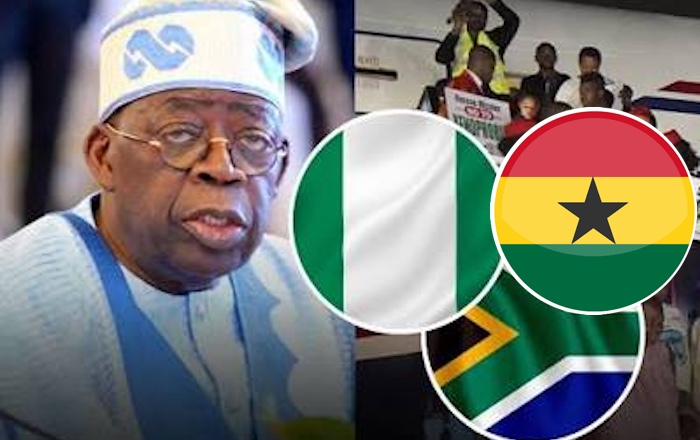
South Africa wants African governments to help cover the cost of repatriating their citizens. But Ghana and Nigeria say they are not responsible for the bill.
Pretoria says it spent roughly $18.5 million on the return of foreign nationals and is seeking reimbursement from countries whose citizens were repatriated.
That effort is already facing resistance.
South Africa’s Home Affairs department says it contacted Malawi, Nigeria and Ethiopia about recovering the costs. The department said its communication with Nigeria and Ethiopia was sent through the Department of International Relations and Cooperation (DIRCO), while Malawi’s government was contacted directly.
Nigeria, however, disputes that account.
Nigeria says no payment request has arrived
Nigeria’s Foreign Ministry says it has not received a formal demand for reimbursement from South Africa.
Foreign Ministry spokesperson Kimiebi Imomotimi Ebienfa told the BBC that Nigerian authorities had received no such request. Nigeria’s Consul General in South Africa, Ninikanwa Okey-Uche, likewise said she had not received a request from Pretoria.
That leaves a clear diplomatic disconnect: South Africa says reimbursement requests have been sent through official channels, while Nigeria says no request has reached its foreign ministry or diplomatic mission.
The disagreement could become significant if Pretoria continues pursuing payment from the countries involved.
Ghana rejects South Africa’s claim
Ghana has taken an even firmer position.
In a statement issued Thursday, Ghana’s Foreign Ministry acknowledged South Africa’s effort to recover about $18 million from several African countries for assistance and services associated with evacuating foreign nationals.
But Accra rejected the idea that Ghana should reimburse South Africa for bringing Ghanaian citizens home.
The Ghanaian government said the evacuation of its nationals was financed by Ghana and Ghanaian partners, adding that it had not asked South Africa to provide financial or material assistance for the operation.
Ghana also sought to reassure its citizens that the country would not be included among governments being asked to repay South Africa for repatriation expenses.
Why South Africa wants the money back
The dispute comes as South Africa deals with the rising cost of immigration enforcement and repatriation.
According to the government’s account, the surge in repatriation activity placed an unexpected strain on the Home Affairs budget. The expenses extend beyond transportation and include accommodation, personnel and other operational requirements.
Pretoria is therefore attempting to recover at least part of that expenditure from governments whose nationals were among those returned.
But the pushback from Ghana and Nigeria exposes a difficult question:
Who should ultimately pay when one country bears the cost of returning another country’s citizens?
For South Africa, recovering the money could help ease pressure on an already stretched government budget. For the countries involved, accepting the bill could establish a precedent for how repatriation costs are divided across Africa.
With Ghana rejecting responsibility and Nigeria saying it has received no formal demand, South Africa’s effort to recoup the $18.5 million is now facing both a financial challenge and a diplomatic one.