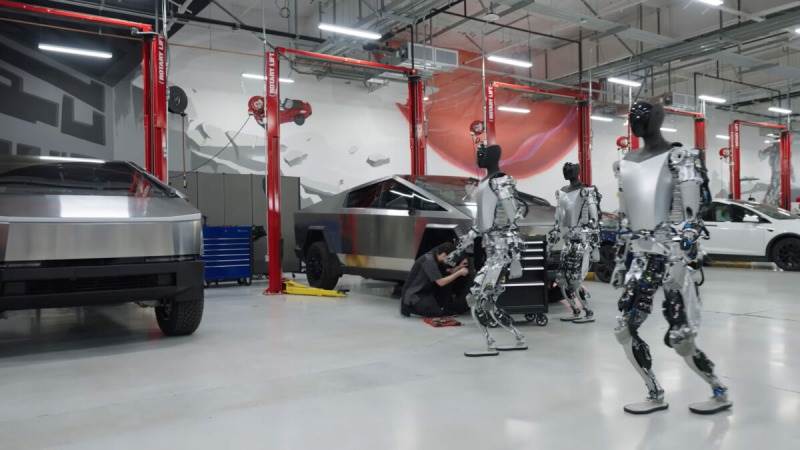
Tesla has reportedly increased production of its Optimus humanoid robot by roughly tenfold in recent months, but the company still faces major engineering and supply-chain challenges as it attempts to reach more than 1,000 robots a week by the end of 2026.
Tesla appears to be making significant progress toward turning Optimus from an experimental humanoid robot into a product that can eventually be manufactured at scale.
According to a report by The Information, Tesla was producing only several dozen Optimus robots per week during the second quarter of 2026. Production has since risen to several hundred units per week, representing an increase of roughly ten times in just a few months.
That sounds like a dramatic acceleration.
But Tesla’s bigger challenge may be what comes next.
The company is reportedly working toward a manufacturing system capable of producing more than 1,000 Optimus robots every week by the end of 2026.
Reaching that target will require Tesla to solve some of the most difficult manufacturing problems associated with humanoid robots, including the production of Optimus’ highly complex hands.
Optimus Production Has Accelerated Rapidly
Tesla has spent years developing Optimus as part of its broader effort to build a general-purpose humanoid robot.
The company’s strategy depends not only on making the robot capable of performing useful tasks, but also on manufacturing it at a sufficiently large scale to make the economics work.
The latest reported production figures suggest Tesla has made substantial progress on that front.
Output reportedly increased from dozens of robots per week to several hundred during recent months.
However, Tesla has not publicly confirmed an exact current weekly production figure.
That means the several-hundred-unit estimate should be treated as a reported figure rather than an official Tesla production count.
Even if accurate, the current level remains well below the company’s longer-term ambitions.
Tesla Wants to Build More Than 1,000 Optimus Robots a Week
Tesla is reportedly targeting production capacity of more than 1,000 Optimus robots per week by the end of 2026.
That would represent another major step up from the current reported production level.
The company’s ambitions ultimately extend far beyond 1,000 units per week.
CEO Elon Musk has previously discussed a potential manufacturing rate of approximately 20,000 robots per week, illustrating the enormous scale Tesla eventually envisions for Optimus.
The company has also said that its Optimus Gen 3 design is intended to become the first version specifically developed for mass production.
Before Tesla can reach those numbers, however, it must establish a manufacturing process capable of producing increasingly complex robotic systems consistently and economically.
The Hands Could Be One of Tesla’s Biggest Problems
Humanoid robots present an unusual manufacturing challenge because their bodies combine many different types of mechanical and electronic systems.
The hands are particularly difficult.
Optimus is designed to perform movements that resemble those of a human hand, requiring a large number of compact motors, actuators, sensors and mechanical components to operate together.
Those parts must not only function individually but also work reliably as a complete system.
Manufacturing them at low volumes for prototypes is one thing.
Producing thousands of identical, reliable hands at industrial scale is considerably more difficult.
According to the report, Tesla has encountered challenges involving the manufacturing and assembly of Optimus’ hands and has continued refining the design as it moves toward a production-ready configuration.
The company is also reportedly dealing with difficulties involving automated manufacturing equipment and the availability of certain suppliers.
Why Humanoid Robots Are So Difficult to Mass Produce
Tesla has extensive experience manufacturing cars at high volume, but Optimus presents a very different engineering problem.
A vehicle contains thousands of components, but its overall architecture is relatively fixed and designed around a small number of major systems.
A humanoid robot has to replicate many of the movements that humans perform naturally.
Its joints need to move precisely. Sensors must constantly provide feedback. Actuators need to deliver controlled force. Software must coordinate all of those systems in real time.
The hands add another layer of complexity because they require precise movement while remaining compact and durable.
Scaling production therefore involves more than simply building additional assembly lines.
Tesla needs to make sure its suppliers can consistently provide highly specialised components while its own factories and automated equipment can assemble those parts with the required precision.
Any bottleneck in one of those areas could slow the entire production process.
Automation Is Another Key Challenge
Tesla’s goal is not simply to assemble Optimus robots using large numbers of human workers.
The company has long emphasised automation as a core part of its manufacturing strategy.
That makes automated production equipment particularly important to Optimus.
If the machinery used to manufacture or assemble the robot cannot operate reliably at high throughput, increasing demand for components will not necessarily translate into higher finished-robot production.
The reported difficulties with automated manufacturing equipment therefore matter almost as much as the robot’s individual components.
Tesla needs the entire production system to work as an integrated process.
That includes component suppliers, robotics, assembly equipment, quality control and final testing.
Optimus Gen 3 Could Be an Important Milestone
Tesla is also developing the next generation of Optimus hardware.
The company is expected to introduce further changes with Optimus V3, including hardware and design revisions intended to make the robot more suitable for large-scale production.
That development could be important because Tesla’s ultimate manufacturing targets require more than simply increasing output of the current design.
The company needs a version of Optimus that can be manufactured efficiently and reliably from the beginning.
Tesla has indicated that Gen 3 is intended to be its first Optimus design aimed specifically at mass production.
That suggests the current production ramp could also function as an important learning phase as Tesla identifies which components and manufacturing processes need to be redesigned before significantly larger volumes become practical.
From Hundreds of Robots to Tens of Thousands
The gap between Tesla’s reported current production and its long-term ambition remains substantial.
Several hundred robots per week would already represent a significant increase compared with the reported output during the second quarter of 2026.
But producing more than 1,000 per week would require another major increase.
And Tesla’s previously discussed goal of around 20,000 robots per week would be a dramatically larger manufacturing operation again.
That makes the next stage of Optimus development less about demonstrating that the robot can be built and more about demonstrating that it can be built repeatedly, reliably and at industrial scale.
For Tesla, that distinction could prove crucial.
Tesla’s Optimus Ambition Is Entering a New Phase
The latest production figures suggest that Tesla’s Optimus programme is moving beyond small-scale prototype manufacturing.
But the company has yet to demonstrate the production volumes it ultimately wants.
The reported rise to several hundred robots per week is a notable increase, while the target of more than 1,000 weekly units would represent another important milestone.
The biggest obstacles may not necessarily be the robot’s ability to walk or perform demonstrations.
Instead, they could be much more mundane — and much harder to solve at scale.
Tesla must manufacture complex hands, secure reliable supplies of specialised components, develop automated production equipment and create a manufacturing process capable of producing thousands of robots consistently.
That is a very different challenge from building a handful of working prototypes.
If Tesla can overcome those bottlenecks, Optimus could move closer to becoming a genuinely mass-produced humanoid robot.
For now, however, the company remains in the difficult middle ground between prototype success and industrial-scale production — and the next 1,000 robots may prove much harder to build than the first few hundred.