Nigeria’s national satellite operator, Nigerian Communications Satellite Limited (NigComSat), has recorded a dramatic increase in revenue, highlighting the growing commercial potential of the country’s space technology sector.
NigComSat’s earnings rose from N650 million in 2023 to more than N2 billion by the end of 2025, representing more than a threefold increase in just two years.
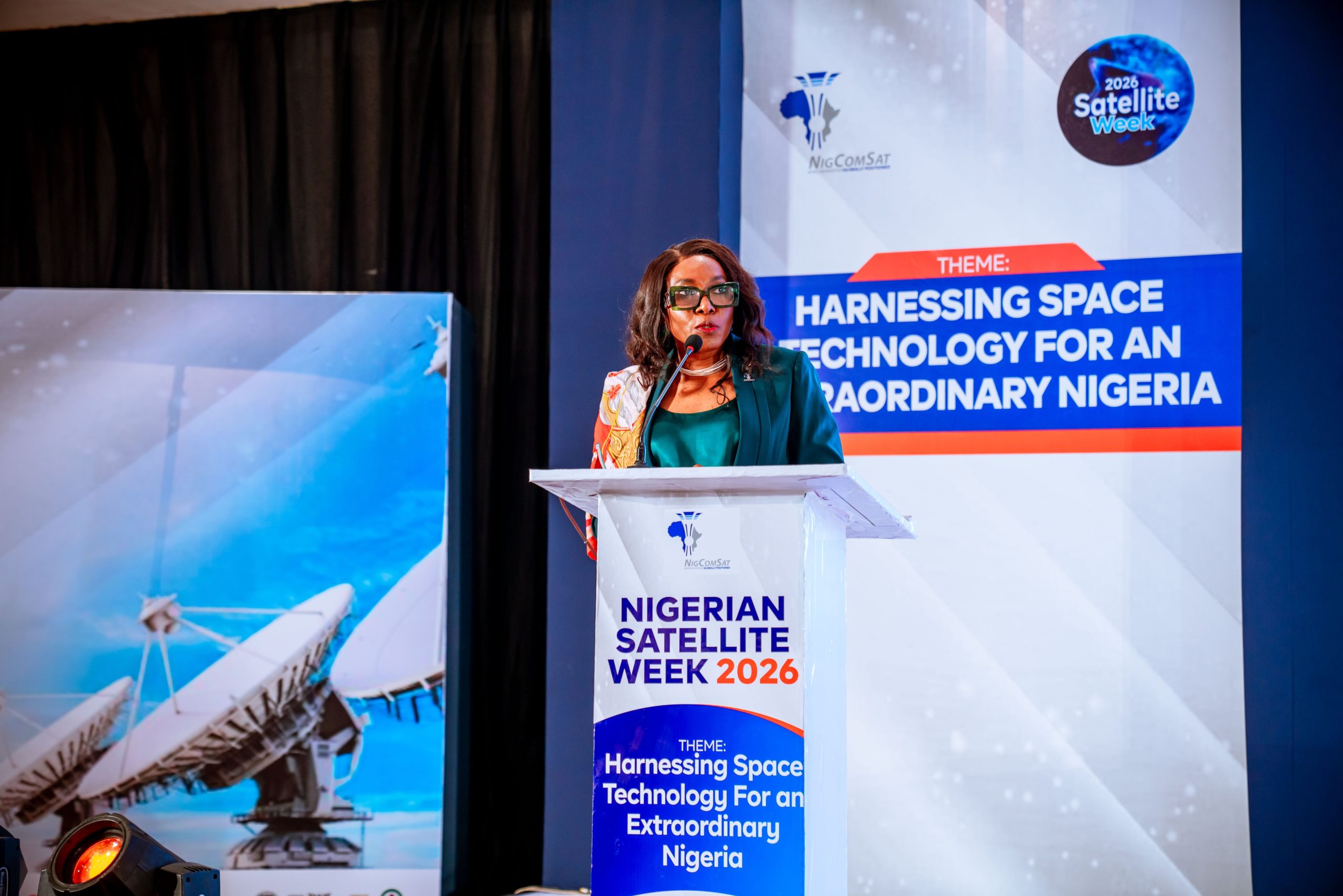
The company’s Chief Executive Officer, Jane Egerton-Idehen, disclosed the figures at the opening of the 2026 Nigerian Satellite Week in Abuja, where government officials, academics and industry stakeholders gathered to discuss Nigeria’s ambitions in space technology.
The event also marks NigComSat’s 20th anniversary, providing an opportunity to assess the organisation’s progress and examine its plans for the next phase of Nigeria’s participation in the global space economy.
You might want to read this: NIGCOMSAT Breaks Silence on NIGCOMSAT-2A, 2B Procurement Allegations
NigComSat Revenue More Than Triples in Two Years
Egerton-Idehen described the sharp increase in revenue as evidence that sustained investment in Nigeria’s space capabilities is beginning to produce stronger commercial returns.
The increase from N650 million in 2023 to more than N2 billion in 2025 represents a significant expansion in the agency’s earnings and reflects growing demand for satellite-enabled services.
According to the CEO, NigComSat has moved well beyond its original role as an operator of a single communications satellite.
The organisation has increasingly developed into a multi-service provider, offering services that support broadband connectivity, broadcasting infrastructure and enterprise customers.
Its services now extend to clients in Nigeria and other parts of Africa, reflecting the growing role of satellite technology in telecommunications and digital infrastructure.
“This is a strong return on Nigeria’s long-term investment in space technology,” Egerton-Idehen said, pointing to rising demand for satellite services across areas such as telecommunications, security and digital infrastructure.
Nigeria’s Space Sector Eyes New Growth
The revenue growth comes as Nigeria seeks to strengthen its position in an increasingly competitive global space economy.
Satellite technology has become important to a wide range of industries, from communications and broadcasting to security, data collection and digital connectivity.
For NigComSat, the expansion of commercial services provides an opportunity to build a more sustainable business model while supporting national technology priorities.
The organisation’s 20th-anniversary milestone also comes at a significant point in its development, with new satellites planned to replace and expand upon existing capabilities.
NigComSat-2A and 2B Satellites Planned for 2028 and 2029
Egerton-Idehen confirmed that preparations have begun for two next-generation satellites, NigComSat-2A and NigComSat-2B.
The satellites are currently scheduled for launch in 2028 and 2029, respectively.
She said the procurement process has been completed, with financing and implementation now moving forward.
The planned satellites are expected to substantially expand Nigeria’s capabilities in several strategic areas.
These include border surveillance, real-time data acquisition, national security operations and regional connectivity.
The new satellites are therefore being positioned not simply as replacements for existing infrastructure but as an important part of Nigeria’s next phase of satellite and digital development.
NigComSat-1R Nears End of Operational Life
The planned launches come as Nigeria’s existing satellite infrastructure approaches an important transition point.
NigComSat-1R, which was launched in 2011, is approaching the end of its expected operational lifespan in 2026.
The development of NigComSat-2A and NigComSat-2B is intended to provide next-generation capacity as the country prepares for the eventual retirement of its current satellite.
Replacing ageing infrastructure is particularly important as demand for broadband connectivity, satellite communications and data services continues to evolve.
The new satellites could give Nigeria additional capacity to respond to those demands while supporting applications that require more advanced space-based capabilities.
From Communications to Security and Data
NigComSat’s expansion reflects how the role of satellites has changed considerably since the organisation began operations.
Modern satellite infrastructure can support far more than conventional communications and broadcasting.
For Nigeria, the planned next-generation satellites are expected to support strategic applications involving security, border monitoring and real-time data.
They are also expected to contribute to regional connectivity, potentially strengthening Nigeria’s ability to provide satellite-enabled services beyond its domestic market.
The combination of commercial and strategic applications could make satellite infrastructure increasingly important to Nigeria’s digital economy and national development plans.
Nigeria’s Position in Africa’s Space Race
NigComSat’s financial performance and expansion plans come against the backdrop of a growing African space industry.
Countries across the continent are investing in satellite technology for communications, environmental monitoring, agriculture, security and other applications.
Egypt and South Africa remain major players in Africa’s broader satellite market, while other countries are also expanding their capabilities.
Against this backdrop, NigComSat’s rising revenue and plans for new satellites could strengthen Nigeria’s position within the West African space ecosystem.
The organisation’s ability to generate more commercial income could also help demonstrate the economic potential of sustained investment in space infrastructure.
What the Next Phase Could Mean for Nigeria
NigComSat’s transformation from a single-satellite operator into a broader provider of satellite-enabled services marks an important stage in the development of Nigeria’s space ambitions.
The increase in revenue provides one measure of that evolution, while the planned NigComSat-2A and 2B satellites point toward a larger technological expansion.
If the planned launches proceed according to schedule, Nigeria will enter the next decade with a new generation of satellite infrastructure designed to support communications, security, data services and regional connectivity.
The challenge will be to translate that infrastructure into sustainable commercial growth while ensuring that satellite technology continues to serve national development priorities.
For now, NigComSat’s trajectory reflects an organisation undergoing significant change. Its revenues have climbed from hundreds of millions of naira to more than N2 billion, its range of services has expanded, and preparations are underway for a new generation of satellites.
As Nigeria marks 20 years of NigComSat, the organisation is positioning its next chapter around a broader ambition: turning investment in space technology into stronger commercial services, improved digital infrastructure and a more prominent role for Nigeria in Africa’s evolving space economy.