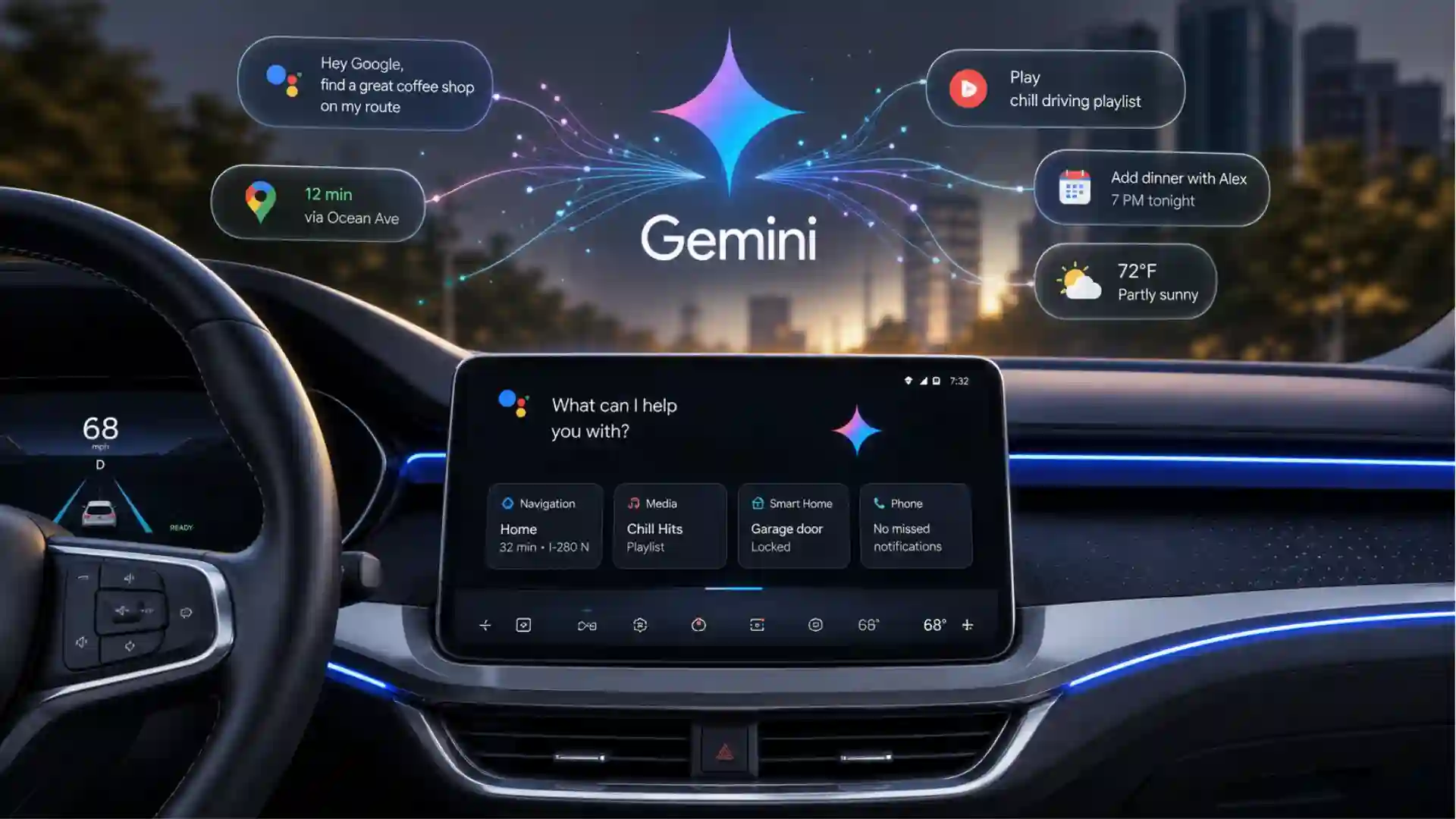
Google is bringing its AI assistant closer to drivers’ everyday lives with a new feature that connects Gemini to personal information across the company’s most popular apps. The upgrade promises to make driving more convenient by helping users manage travel plans, check schedules, and get personalized answers without manually searching through multiple applications.
But there is a trade-off. As Gemini becomes more familiar with users’ routines, preferences, and personal activities, the technology could also deepen their dependence on Google’s growing ecosystem of connected services.
Announced on Tuesday, the new Personal Intelligence with Gemini feature will allow the AI assistant in compatible vehicles to draw on information from Gmail, Google Calendar, Google Maps, YouTube, Google Search history, and other connected Google services. The goal is to give drivers more relevant assistance by connecting information that would otherwise remain scattered across different apps.
The rollout will begin with Android Auto and expand to vehicles equipped with Google Built-in in the coming months. While the update could make in-car AI substantially more useful, it also raises important questions about personal data, privacy, and how much information drivers want their digital assistants to know.
Google Gemini Is Becoming a More Personal In-Car Assistant
Google has been steadily expanding Gemini’s role in connected vehicles. The company introduced Gemini to Android Auto in November, bringing its AI assistant into the driving experience. Now, the latest upgrade aims to move beyond answering individual questions by allowing the assistant to use information from multiple connected services.
Rather than treating every request as an isolated conversation, Gemini will be able to draw connections between a driver’s schedule, travel arrangements, and other relevant information, provided the necessary services are connected.
For example, someone heading to the airport could receive an alert that their flight has been delayed because the relevant information appears in their calendar or other connected sources.
That kind of assistance could reduce the need to switch between navigation, email, and travel applications while on the road. Instead of searching for details manually, drivers could ask Gemini for the information they need in a conversational way.
The broader idea is to make the AI assistant feel less like a voice-controlled search engine and more like a personal assistant that understands the context behind a request.
How Personal Intelligence Works With Android Auto and Google Built-in
Google plans to introduce Personal Intelligence in vehicles through two separate platforms: Android Auto and Google Built-in.
Android Auto: Your Phone Connects Gemini to the Car
Android Auto runs through a compatible smartphone and projects supported navigation, media, and messaging features onto a vehicle’s infotainment display. The phone communicates with the car’s system, allowing drivers to access supported applications without relying entirely on the vehicle’s own software.
Google says Personal Intelligence will begin rolling out through Android Auto immediately following the announcement.
Because Android Auto works with a user’s phone, the platform offers a way to bring the upgraded Gemini experience to compatible vehicles without requiring every car to have Google’s software built directly into its operating system.
Google Built-in: Gemini Integrated Into the Vehicle
Google Built-in takes a different approach. Instead of depending on a phone to provide the connected experience, it integrates Google software and services directly into the vehicle.
Cars equipped with Google Built-in can offer supported Google services through their own infotainment systems.
Google plans to expand Personal Intelligence to these vehicles in the coming months, although availability will depend on the supported software and rollout arrangements.
Together, the two platforms give Google a way to extend its personalized AI experience across a broad range of compatible vehicles.
From Flight Delays to Travel Questions, Gemini Could Connect the Dots
The most significant change is not simply that Gemini can answer questions. It is that the assistant can use relevant information from different Google services to provide answers tailored to a particular situation.
Consider a driver traveling to the airport. Previously, checking a flight’s departure gate might require opening a travel confirmation or searching for the latest flight information. Checking whether the flight is still on schedule could involve another search or application.
With Personal Intelligence enabled and the relevant information available, a driver could ask Gemini for the flight gate and immediately follow up by asking whether the flight is still on time.
Google says Gemini can respond to both questions together, making the interaction more natural and reducing the need to navigate between separate services.
The same underlying approach could make other everyday tasks easier. Calendar information could help provide context for a scheduled appointment, while relevant details in Gmail could help answer questions about travel arrangements.
The potential benefit is convenience: Drivers spend less time locating information and more time focusing on the road.
However, the usefulness of these responses will depend on the information Gemini can access, how accurately it interprets that information, and whether the connected services contain the details needed to answer a request.
Personalization can make an assistant more helpful, but it does not guarantee that every response will be complete or correct.
The Feature Could Make Google’s Ecosystem Even More Valuable
The new functionality also highlights Google’s broader strategy of connecting its products through artificial intelligence.
Millions of people already use Google services for email, navigation, calendars, online searches, and entertainment. By linking these activities through Gemini, Google can offer an experience that becomes more useful as users rely on more of its products.
For example, an email containing travel details could become relevant to a question asked through the car’s voice assistant. A calendar entry could provide context for a navigation-related request. Information from different services could work together rather than remaining confined to separate applications.
For consumers, this integration could eliminate small but frequent inconveniences. Instead of remembering where a piece of information is stored, users could ask Gemini to help retrieve it.
For Google, the strategy could strengthen the appeal of its connected ecosystem. The more services users connect, the more opportunities Gemini may have to provide context-aware assistance.
That creates a familiar technology trade-off. A tightly integrated ecosystem can be convenient, but it can also make users more dependent on a single company’s software and services.
As AI assistants become more capable, the competition between technology companies may increasingly revolve around who can deliver the most useful personalized experience across phones, computers, homes, and vehicles.
What Does Gemini’s Personal Intelligence Mean for Privacy?
The ability to connect information across multiple apps could be useful, but it may also make some drivers uncomfortable.
Gmail can contain personal correspondence and travel confirmations. Calendars can reveal appointments and routines. Search history can reflect individual interests, while other connected services may provide additional context about a user’s activities.
Bringing information from these sources into an in-car assistant raises reasonable questions about what data is accessed, how it is used, and how much control users have over the process.
Google says Personal Intelligence is optional. Drivers must opt in before the feature can use connected information for personalized assistance.
The company also says users can turn the feature on or off whenever they choose and select which applications they want to connect.
These controls give users the ability to decide how extensively they want to integrate their Google accounts with Gemini.
Someone who wants help with travel plans, for example, may prefer to connect Gmail and Google Calendar while leaving other services disconnected.
Nevertheless, opting in should be an informed decision. Users may want to review the available settings and understand which services are connected before enabling personalization, particularly when using an assistant in a shared vehicle.
The announcement emphasizes user control, but the precise privacy implications depend on the feature’s implementation and the applicable data-handling policies.
When Will Personal Intelligence Arrive in Cars?
Google is introducing Personal Intelligence through Android Auto first, with the initial rollout beginning on the day of its announcement. The company plans to bring the feature to vehicles with Google Built-in in the following months.
The update builds on two earlier developments: Gemini’s introduction to Android Auto in November and the broader rollout of Gemini’s Personal Intelligence capabilities in the United States in March, followed by beta availability in international markets.
Availability may vary depending on the platform and supported services, so not every driver should expect to receive the same functionality at the same time.
As the rollout progresses, the key question will be whether the convenience of connected, personalized assistance outweighs concerns about data integration and dependence on Google’s services.
Is a More Personalized AI Assistant Worth It?
Google’s latest Gemini upgrade points toward a future in which cars become more than transportation devices with voice controls and navigation screens. They could increasingly function as connected personal assistants capable of using information from across a driver’s digital life.
For people who already rely heavily on Google services, the benefits may be straightforward: fewer manual searches, more relevant answers, and easier access to important information while traveling.
For others, the idea of an AI assistant drawing on email, calendars, search activity, and other personal data may feel like a step too far.
The good news is that Google says the feature requires users to opt in and allows them to control which services they connect.
Ultimately, Gemini’s success in the car may depend on striking the right balance between personalization, convenience, and privacy. If Google can make its assistant genuinely helpful without leaving drivers uncertain about how their information is being used, Personal Intelligence could become a meaningful improvement to the connected driving experience.
If it cannot, the very feature designed to make Gemini feel more personal could become one of the biggest reasons some users choose not to enable it.