
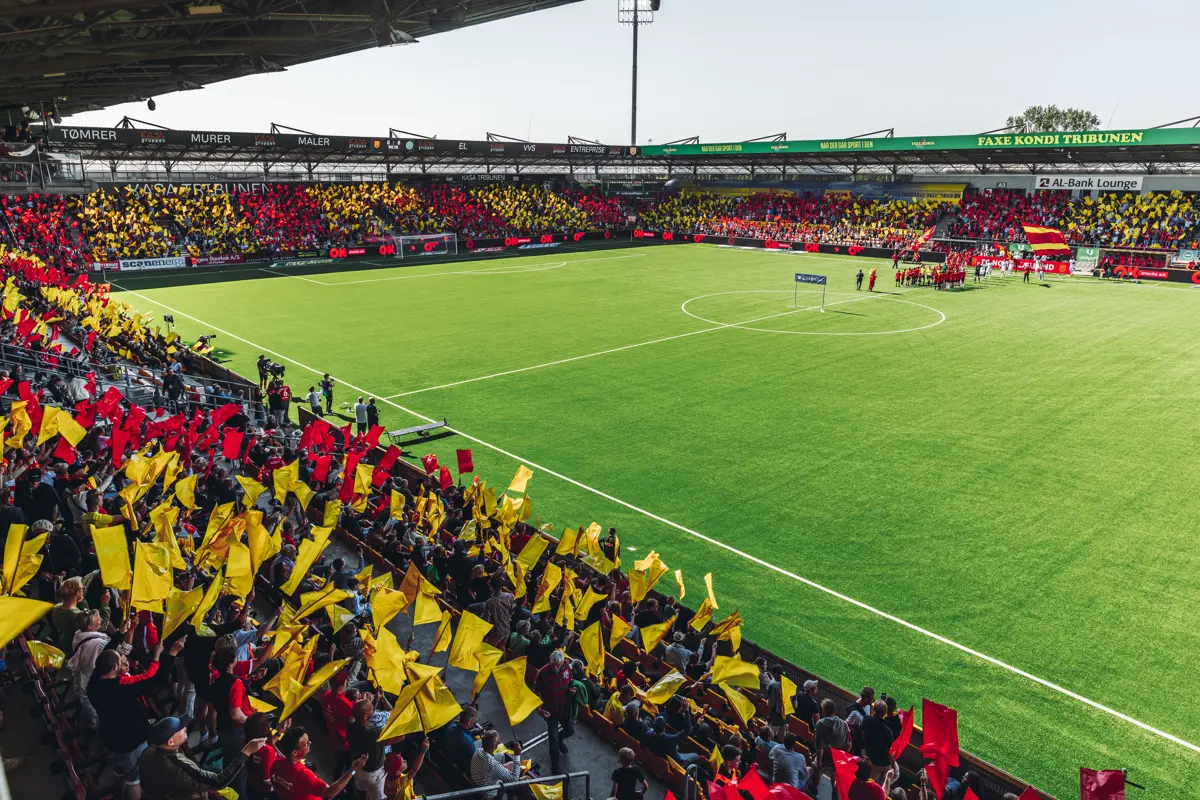
Almost half of FC Nordsjælland’s league minutes in 2026 have gone to players under 21. That is not just impressive. It is the highest rate recorded among top-flight clubs worldwide.
The Danish side leads the latest CIES Football Observatory ranking, which examined 50 leagues across the globe. Nordsjælland gave U21 players 48.1% of its domestic league playing time, comfortably ahead of RC Strasbourg at 37.9% and Partizan Belgrade at 37%.
And there is a reason the number is so high.
Nordsjælland have made youth development their identity
Young players are not a side project at Nordsjælland. They are the club’s model.
The club combines its academy structure with the Right to Dream network in Ghana, developing teenagers before moving many of them into larger European markets.
What makes the strategy even more striking is the team’s performance. Despite relying so heavily on youth, Nordsjælland sit second in the Danish Superliga, only one point behind FC Midtjylland and with a match in hand.
That turns an impressive statistic into a competitive statement.
Strasbourg are taking a very different route
RC Strasbourg finished second in the CIES ranking, with U21 players accounting for 37.9% of their league minutes.
The French club used 20 different U21 players during the period studied—the largest number among the teams near the top of the ranking. Strasbourg also averaged 4.10 U21 starters per match, while their average starting XI was just 22.07 years old.
Youth development has therefore become one of the clearest features of the club under BlueCo, the ownership group that also controls Chelsea.
But there is a crucial difference.
For Nordsjælland, developing young talent is the club’s long-established identity. At Strasbourg, it is increasingly tied to a broader multi-club strategy.
The Chelsea connection is impossible to ignore
The relationship became particularly visible during the summer transfer window.
Five players moved directly from Chelsea to Strasbourg:
- Filip Jörgensen — loan
- Genesis Antwi — loan
- Dário Essugo — loan
- Omari Kellyman — permanent transfer
- Deivid Washington — permanent transfer
The traffic also went the other way. Chelsea signed Valentín Barco and Emanuel Emegha from Strasbourg during the same window.
By late August, 14 players had moved between the clubs since BlueCo acquired Strasbourg in 2023. The deadline-day moves involving Essugo and Washington pushed that total even higher.
The model can produce talented players, competitive results and significant transfer income.
It can also create a perception problem.
Strasbourg’s biggest question is not about youth
Some Strasbourg supporters have argued that their club is effectively functioning as a development pathway for Chelsea.
President Marc Keller has repeatedly rejected that characterization.
But the concern became harder to ignore after Liam Rosenior left Strasbourg for Chelsea earlier this year. His time in London lasted only three months, while both clubs subsequently endured disappointing seasons: Strasbourg finished one point short of European qualification, and Chelsea ended the campaign in tenth place.
That episode added another layer to an already complicated relationship.
The global picture
Nordsjælland and Strasbourg were not the only clubs putting teenagers at the centre of their teams.
Melbourne City ranked fifth worldwide, making them the highest-placed non-European club, with U21 players responsible for 32.9% of their league minutes.
San Diego FC followed at 30.6%. The club is owned by the same group behind Nordsjælland.
Among Europe’s biggest clubs, Paris Saint-Germain recorded 23%, while RB Leipzig reached 20.6%. Barcelona, heavily reliant on its La Masia pipeline and the emergence of Lamine Yamal, recorded 20.3%.
In England, Bournemouth led the Premier League rankings at 19.4%, using six different U21 players during the period examined.
Two youth models. One big question.
The CIES figures reveal more than a list of clubs giving teenagers playing time.
They show two very different philosophies of youth development.
Nordsjælland have built their competitive identity around finding, developing and selling young talent. Their current league position suggests that approach can work without sacrificing results.
Strasbourg are following a more interconnected model. Their young players are developing within a network where Chelsea sits at the other end of the pathway.
And that creates the question worth watching.
If Strasbourg continues producing players who perform at the highest level, how long will it be before Chelsea comes calling?