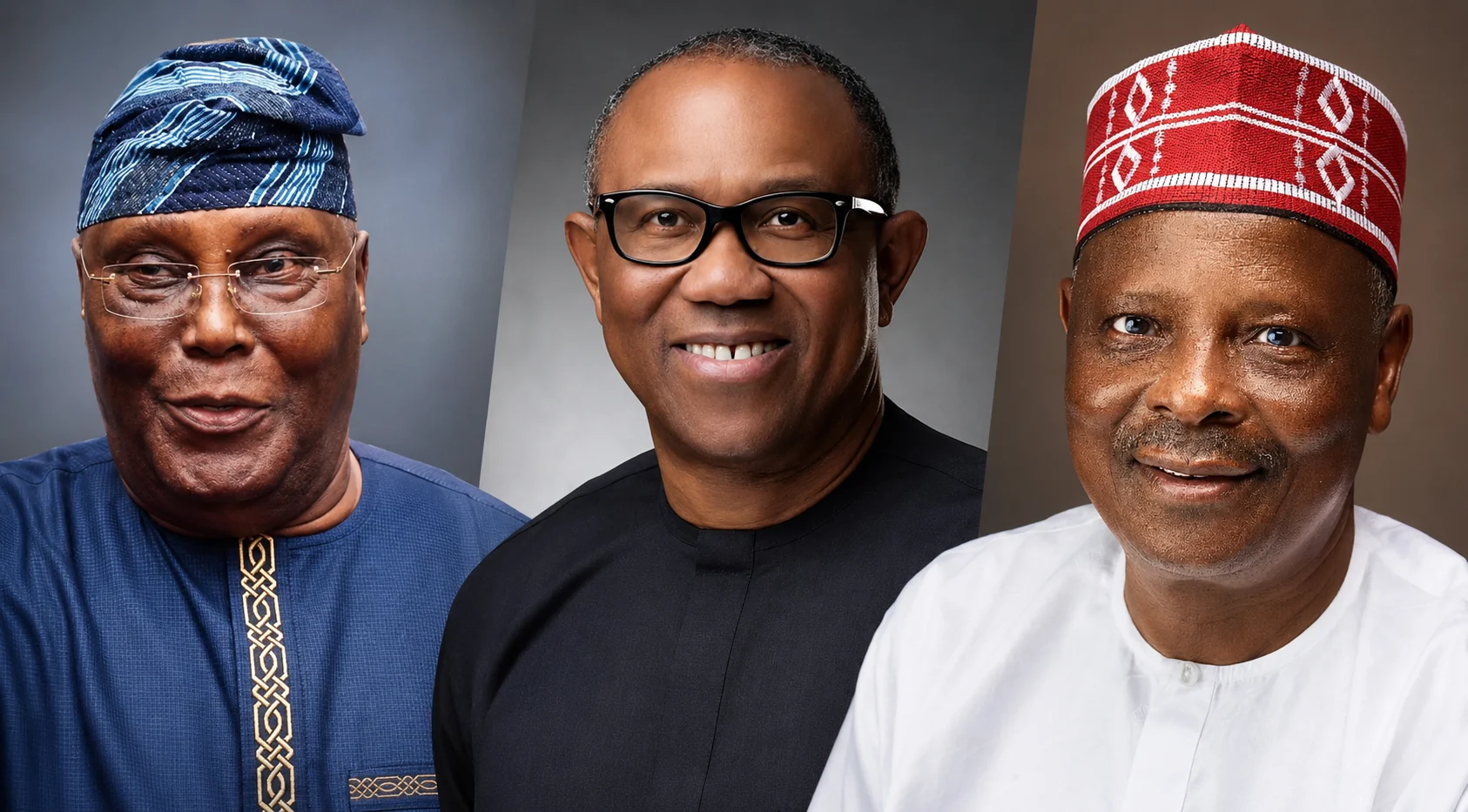
The political battle ahead of Nigeria’s 2027 presidential election is beginning to expose fresh divisions within the opposition, as former Kano State Governor Rabiu Kwankwaso has called on former Vice-President Atiku Abubakar to abandon his presidential ambition and support Labour Party’s 2023 presidential candidate, Peter Obi.
Kwankwaso, who is the vice-presidential candidate of the Nigeria Democratic Congress (NDC), argued that the presidency should remain in the South for the next election, insisting that it would be inappropriate for another northern candidate to seek power after President Bola Tinubu’s administration.
The former governor made his position known on Sunday during an interactive session with journalists at his residence in Kano, where he expressed concern about developments within the African Democratic Congress (ADC), the political platform on which Atiku is pursuing his 2027 presidential ambition.
According to Kwankwaso, attempts to present another northern presidential candidate could undermine the understanding surrounding the rotation of power between Nigeria’s northern and southern regions.
He maintained that allowing Peter Obi to emerge as the next president would promote political balance, strengthen national unity and give the South an opportunity to complete its expected turn in the country’s leadership arrangement.
His comments come as opposition parties and political figures continue positioning themselves ahead of the 2027 general election, raising concerns that disagreements over presidential candidates could weaken efforts to build a united opposition against the ruling party.
Kwankwaso Questions Atiku’s 2027 Presidential Ambition
During his interaction with journalists, Kwankwaso criticised the political developments surrounding the ADC, particularly the possibility of the party presenting Atiku Abubakar as its presidential candidate.
He argued that such a move could create unnecessary political tension because, in his view, the South should retain the opportunity to produce Nigeria’s next president.
The former governor expressed dissatisfaction with what he described as efforts by some political actors to introduce another northern candidate into the presidential contest despite the existing understanding about power rotation.
“What is happening in the ADC will not help us,” Kwankwaso said.
He further suggested that those promoting a northern presidential candidate should recognise the importance of maintaining the country’s established political balance.
Although he acknowledged that Nigeria’s Constitution does not formally require presidential power to rotate between the North and South, Kwankwaso insisted that political leaders should consider the broader implications of their decisions.
His argument is based on the principle that when one region has occupied the presidency for two consecutive terms, the other should be given an opportunity to produce the next leader.
Under this arrangement, Kwankwaso believes that the South should be allowed to retain the presidency in 2027 rather than returning power to the North.
Former Kano Governor Says Zoning Is About Political Understanding
Kwankwaso also addressed the constitutional status of zoning, acknowledging that the arrangement is not expressly provided for in Nigeria’s Constitution.
However, he argued that the absence of a constitutional provision does not mean political parties and their leaders should disregard the principle.
According to him, common sense and the need for national harmony should guide decisions about the distribution of political power.
He warned that presenting another northern presidential candidate while the South is expected to complete its turn could create unnecessary disagreements and weaken peaceful coexistence.
For Kwankwaso, the issue goes beyond the ambitions of individual politicians. He believes political leaders must consider the potential consequences of their decisions for national unity and the relationship between the country’s different regions.
His position reflects the continuing debate over zoning and power rotation in Nigerian politics, particularly as political parties begin preparing for another presidential election.
Although zoning remains a political understanding rather than a constitutional requirement, it has continued to influence presidential contests and negotiations among major political groups.
Kwankwaso Recalls Sacrificing His Presidential Ambition for Peter Obi
In defending his position, Kwankwaso referred to his previous attempts to become Nigeria’s president, explaining that he had contested the presidential election three times before deciding to step aside in support of Peter Obi.
He presented the decision as a personal sacrifice made in the interest of what he considered a more credible candidate from the South.
“I sacrificed my ambition for Peter Obi because he is credible and from the South,” he said.
The former governor’s remarks suggest that he views his earlier decision to support Obi as consistent with his current position on the need to maintain the North-South power arrangement.
Kwankwaso also argued that supporting an Obi presidency would not permanently prevent northern politicians from seeking the country’s highest office.
According to him, the presidency would return to the North after Obi completes his administration.
His comments indicate that he sees the proposed arrangement as part of a broader political understanding in which both regions would have opportunities to produce the country’s leader.
The former Kano governor’s intervention also places renewed attention on the relationship between his political ambitions and his position on opposition cooperation ahead of the next general election.
Opposition Faces Fresh Concerns Over Possible Division in 2027
Kwankwaso’s comments come amid growing concerns that disagreements over presidential candidates could divide opposition supporters and reduce their chances of mounting a united challenge in 2027.
The possibility of Atiku and Obi contesting against each other has become an important issue in discussions about opposition strategy.
Both politicians have significant political followings and were among the leading contenders in the 2023 presidential election.
Atiku contested under the Peoples Democratic Party (PDP), while Obi represented the Labour Party.
Their participation in the same election contributed to a contest in which opposition votes were distributed among different candidates.
With both figures potentially seeking another opportunity in 2027, some opposition stakeholders are concerned that a similar situation could emerge if political negotiations fail to produce a broadly acceptable candidate.
Kwankwaso’s appeal to Atiku appears to be connected to these concerns, as he believes allowing Obi to emerge as the opposition’s preferred presidential candidate could help avoid another divided contest.
However, the question of who should lead the opposition remains complicated by competing political interests, regional considerations and the ambitions of influential political figures.
The challenge for opposition parties will be finding common ground without creating further divisions among their supporters.
Why Peter Obi Remains Central to the Zoning Debate
Peter Obi’s position in the discussion is closely connected to the argument that the South should retain the presidency in 2027.
Kwankwaso described the former Anambra State governor as a credible candidate and argued that his emergence would be consistent with the regional power-sharing arrangement he supports.
By advocating for Obi, Kwankwaso is effectively asking other opposition politicians, particularly Atiku, to prioritise regional balance over individual presidential ambitions.
However, the debate also raises questions about whether political parties should determine their candidates primarily through zoning agreements or allow internal democratic processes to guide their decisions.
Since zoning is not constitutionally guaranteed, political parties remain central to determining how the principle is applied during candidate selection.
The positions of major political stakeholders will therefore be important in shaping the direction of opposition negotiations as the 2027 election approaches.
Atiku and ADC Yet to Respond to Kwankwaso’s Remarks
At the time of filing the report, neither Atiku Abubakar nor the African Democratic Congress had publicly responded to Kwankwaso’s comments.
It also remained unclear whether the former vice-president would reconsider his presidential ambition in response to the former Kano governor’s appeal.
The absence of an immediate response leaves the disagreement unresolved, particularly as political discussions surrounding the opposition’s 2027 strategy continue.
Kwankwaso’s intervention, however, has added another dimension to the debate over who should emerge as the opposition’s presidential candidate.
His position is clear: he wants Atiku to step aside and support Peter Obi, arguing that the South should produce Nigeria’s next president before power returns to the North.
2027 Presidential Race: Will Opposition Leaders Agree on One Candidate?
As preparations for the 2027 general election gather momentum, the ability of opposition leaders to manage their differences could become a major factor in determining their political strategy.
Kwankwaso’s latest comments highlight the competing interests surrounding zoning, regional representation and individual presidential ambitions.
While he believes supporting Obi would promote political balance and reduce the possibility of opposition divisions, Atiku’s position and the decisions of other political stakeholders will also shape the debate.
For now, the question remains whether opposition leaders can reach an agreement on a common presidential candidate or whether competing ambitions will produce another divided contest.
With the 2027 election approaching, the debate over Atiku, Obi and the rotation of presidential power is likely to remain a significant issue in Nigeria’s political discussions.